Alexander Grodzinski
-
Gesamte Inhalte
14.305 -
Benutzer seit
Alle Inhalte von Alexander Grodzinski
-
John Carpenter - Terror takes shape
Alexander Grodzinski antwortete auf Alexander Grodzinskis Thema in Komponisten Diskussion
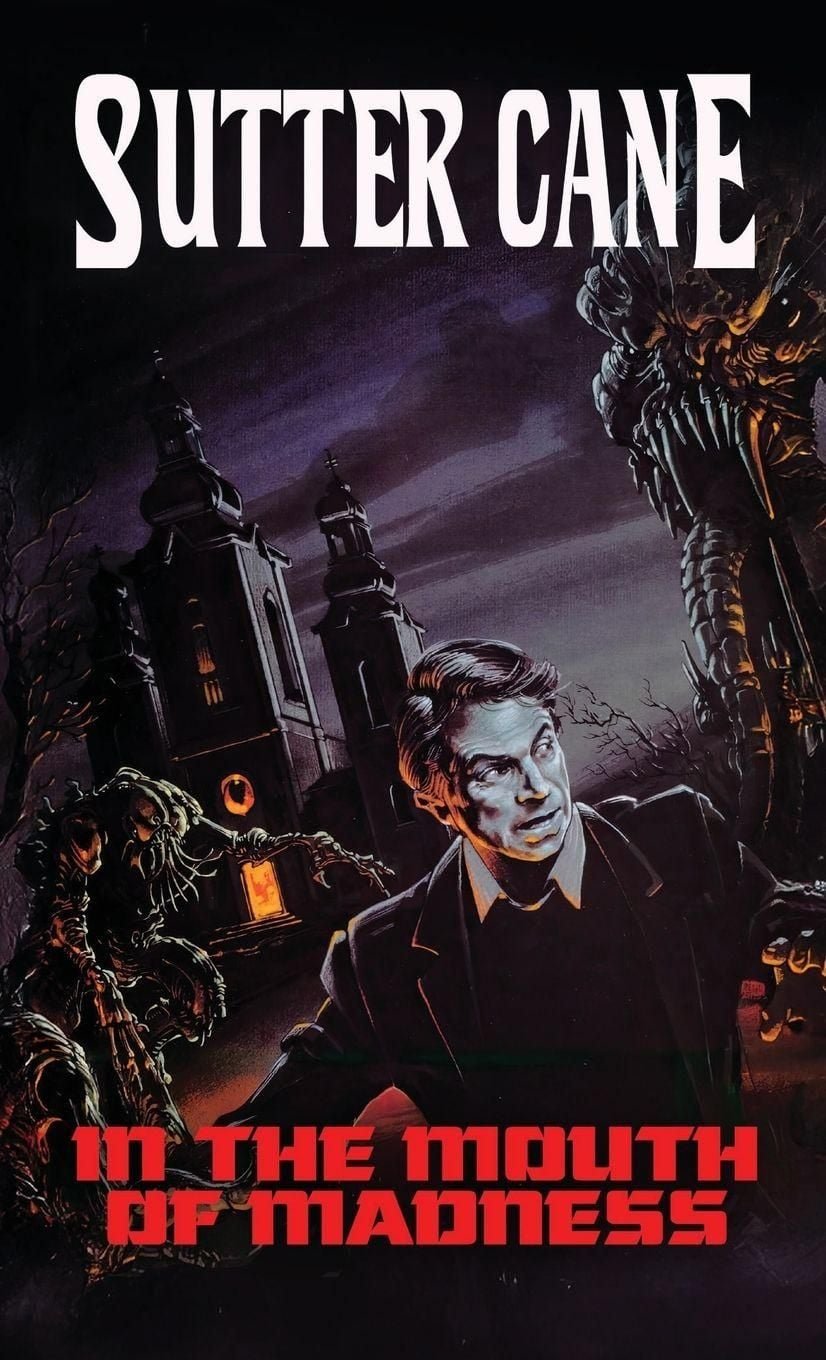
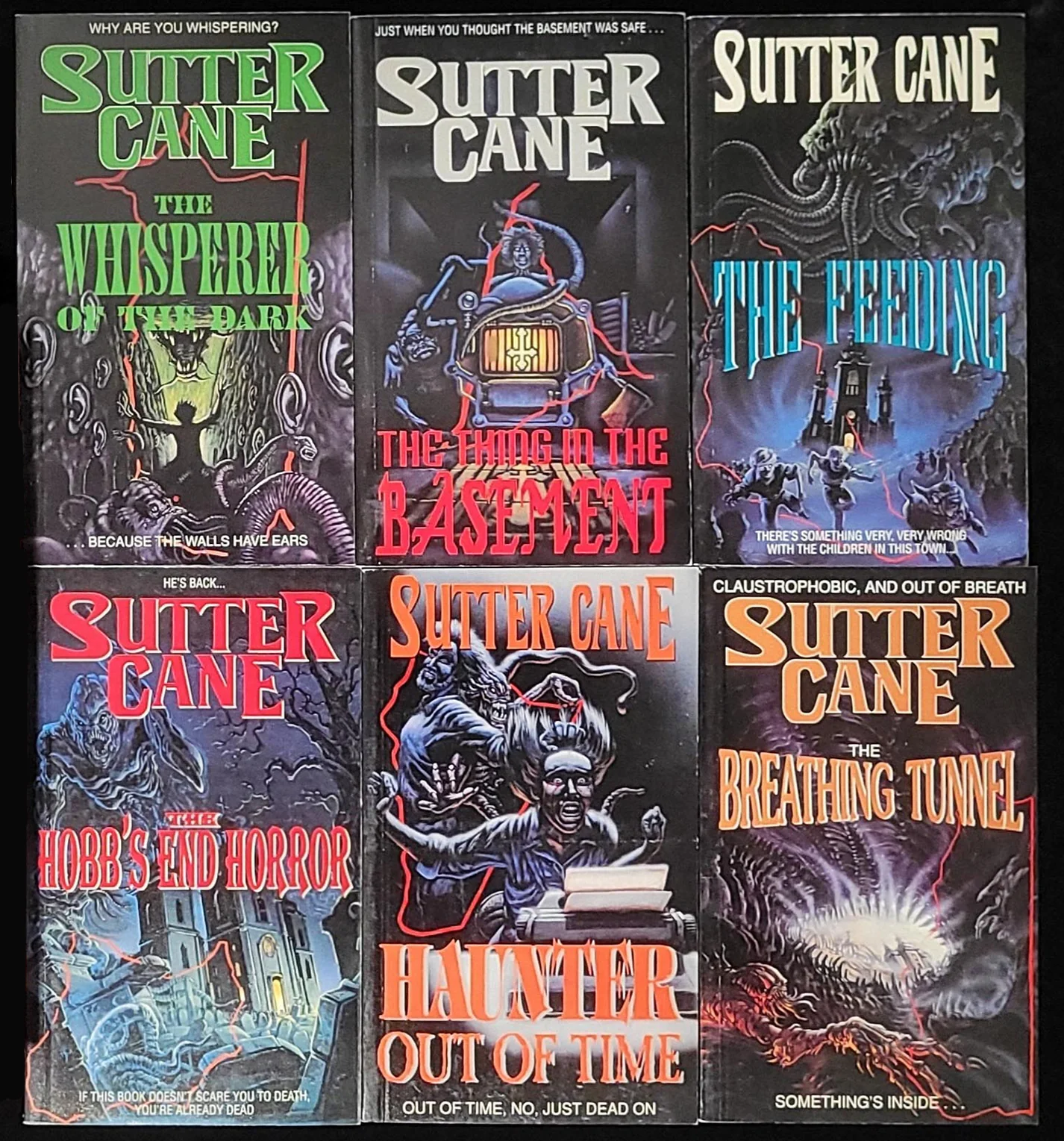
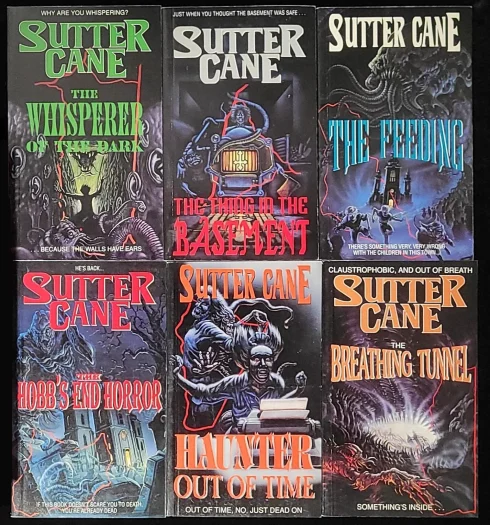
Den Roman des Horrorautors Sutter Cane aus IN THE MOUTH OF MADNESS gibt es nun tatsächlich als Buch zu kaufen. Es ist im Grunde der Film als Roman, wie jeder weiß, der den Film gesehen hat. Gibt es als gebundenes Buch und als Taschenbuch. Unabhängig davon hat Carpenter vor einiger Zeit die anderen Bücher Sutter Canes aus dem Film, die dort als Props verwendet wurden, zum Kauf angeboten.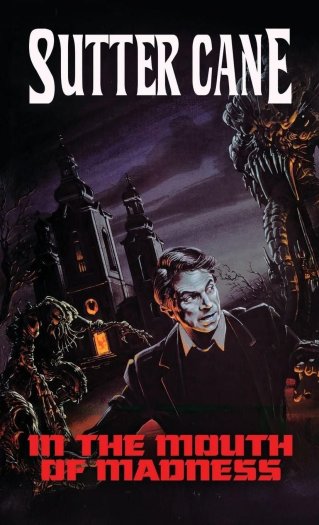
-
LLLCD 1687 Music composed, arranged and conducted by John Barry Title song sung by Shirley Bassey Lyrics by Don Black Limited edition of 5,000 units Exclusive release Sold exclusively at 007Store.com and lalalandrecords.com for the first 90 days of release La-La Land Records, Metro-Goldwyn-Mayer and Universal Music Enterprises proudly present the 55th anniversary remastered and expanded 2-CD re-issue of renowned composer John Barry’s original motion picture score to the seventh James Bond film, DIAMONDS ARE FOREVER. Produced by Albert R. Broccoli and Harry Saltzman, the 1971 film stars Sean Connery, after a one picture absence, as James Bond 007 and is directed by Guy Hamilton, returning for his second film in the series. Composer John Barry continues on his mission of creating classic Bond music, unleashing another epic orchestral wonder, pulsating with thematic motifs, and swirling all the film’s thundering action, spycraft and sensuous romance into an intoxicating, exhilarating knockout of a score. Included within this 2-CD set is the iconic title song “Diamonds Are Forever” by Barry and lyricist Don Black performed by Shirley Bassey in English and Italian! Expanded beyond previous soundtrack editions, DIAMONDS ARE FOREVER sparkles like never before within this deluxe presentation. Produced by Neil S. Bulk, mixed by Chris Malone and mastered by Doug Schwartz, the release has been sourced from the original 1" 8-track analog scoring masters. The "Score Presentation" reflects the takes and sequencing used for the film, while the "Original Soundtrack Album" has been newly edited and replicates the takes, edits and sequencing of the 1971 soundtrack. Alternate versions and additional source cues round out the package. Featuring sharp art direction by Dan Goldwasser, with a new front cover designed by Jim Titus, the release also includes exclusive, in-depth liner notes by journalist and author Jon Burlingame. Limited to 5000 units this release is not expected to be around... forever. THIS IS A COMPACT DISC RELEASE DISC 1 SCORE PRESENTATION 1:08:39 1. Gun Barrel And Manhunt 3:11 2. Diamonds Are Forever (Film Version) (Performed by Shirley Bassey) 2:52 3. Mr. Wint And Mr. Kidd 2:33 4. Mrs. Whistler And Hovercraft To Holland 2:02 5. Diamonds Are Forever 3:45 6. Tiffany Case 3:47 7. Peter Franks 3:02 8. Los Angeles To Las Vegas 3:02 9. Slumber Inc. 2:22 10. The Whyte House 2:22 11. Plenty, Then Tiffany 2:28 12. Circus Circus (Film Version) 2:49 13. We Lost Her And WW Tectronics 4:06 14. Stealing The Moon Buggy 1:00 15. Moon Buggy Ride (Film Version) 3:19 16. Scaling The Whyte House 1:11 17. Death At The Whyte House 3:45 18. Bond Smells A Rat 1:54 19. Bond Meets Bambi And Thumper (Extended Version) 2:11 20. Breaststroke Lessons 1:06 21. Q's Trick 2:27 22. 007 And Counting 3:32 23. Baja? 2:16 24. Oil Rig Attack 1:37 25. To Hell With Blofeld 1:35 26. Diamonds Are Forever (Extended Version) 2:47 27. The End Of Mr. Wint And Mr. Kidd :55 ALTERNATE VERSIONS 7:31 28. Diamonds Are Forever (Alternate) (Performed by Shirley Bassey) 3:18 29. Moon Buggy Ride (Alternate Segment) 1:59 30. Bond Meets Bambi And Thumper (Alternate) 2:07 TOTAL DISC 1 TIME: 1:16:11 DISC 2 ORIGINAL SOUNDTRACK ALBUM 34:39 1. Diamonds Are Forever (Performed by Shirley Bassey) 2:42 2. Bond Meets Bambi And Thumper 2:06 3. Moon Buggy Ride 3:14 4. Circus Circus 2:56 5. Death At The Whyte House 3:45 6. Diamonds Are Forever 3:45 7. Diamonds Are Forever 2:33 8. Bond Smells A Rat 1:54 9. Tiffany Case 3:46 10. 007 And Counting 3:32 11. Q's Trick 2:26 12. To Hell With Blofeld 1:35 ADDITIONAL MUSIC 14:26 13. Slumber Inc. (Wild Organ) 1:48 14. Hotel Tropicana :40 15. The Whyte House (Extended Version) 4:27 16. Circus Circus (With Overlays) 2:57 17. Water Balloons 3:42 18. Zambora :44 BONUS TRACK 19. Vivo di diamanti (Performed by Shirley Bassey) 2:42 TOTAL DISC 2 TIME: 51:57 TOTAL ALBUM TIME: 2:08:08
-
LLLCD 1689 Music Adapted and Conducted by Jerry Fielding Limited edition of 1000 units La-La Land Records and Paramount Pictures celebrate the 50th Anniversary of the classic 1976 big-screen little league baseball comedy THE BAD NEWS BEARS with this expanded and remastered CD release of acclaimed composer Jerry Fielding’s (THE WILD BUNCH, THE MECHANIC) adapted motion picture score to this beloved film, starring Walter Matthau and Tatum O’Neil and directed by Michael Ritchie. Composer Jerry Fielding finds the perfect “pitch” for the movie’s bumbling, big-hearted, but foul-mouthed team of youngsters with his delightful and inspired orchestral score – a wonderous adaptation of composer Georges Bizet’s famed opera CARMEN. Fielding’s inventive reworking of CARMEN nourishes all the heart, laughs and character drama in one of filmdom’s most cherished sports underdog stories. Now, this limited edition CD re-issue brings THE BAD NEWS BEARS score back in print, sounding better-than-ever, with additional music previously unreleased, and just in time for Baseball Season! Produced by Dan Goldwasser and mastered by Doug Schwartz, this special CD release is limited to 1000 units and includes exclusive, in-depth liner notes by writer and re-issue album Associate Producer John Takis. The grand slam art design is by Dan Goldwasser. TRACK LISTING: SCORE PRESENTATION 1. Hang In There 2:00 2. A Really Fine Thing 1:03 3. Play Ball 1:12 4. Bears Play 0:37 5. Silent Moment With Merchants (Mono) 0:48 6. Beer Cans 0:37 7. First Major Loss 2:32 8. Goodbye Buttermaker 0:59 9. Amanda’s Theme 0:42 10. Bad News For The Athletics 1:26 11. Around Them Bases 1:07 12. Street Pitching 2:26 13. Cool Karl Karonsky 1:34 14. Out Of Pinball Shop 0:24 15. Second Amanda Theme 0:30 16. Kelly’s Big Score (Mono) 0:24 17. Montage #1 1:19 18. Kelly Rebels 1:16 19. Tiny Tears 1:05 20. Amanda Gets Spiked 0:45 21. Buttermaker Goes Corrupt 0:32 22. Joe Won’t Throw 1:14 23. Montage #2 (Mono) 1:04 24. Lupus’ Big Catch 0:31 25. Cliff Hanger 2:54 26. Next Year 0:52 27. End Credits 0:58 28. The Bad News Bears Song 1:43 TOTAL SCORE TIME 32:34 ALTERNATES 29. Play Ball (Original) 1:12 30. Play Ball (Alternate) 1:11 31. Silent Moment With Merchants (Short Alternate) (Mono) 0:17 32. First Major Loss (Film Version) 1:42 33. First Major Loss (Alternate) 1:42 34. Street Pitching (Film Version) (Mono) 1:27 35. Kelly Rebels (Alternate Mix) 1:17 36. Buttermaker Goes Corrupt (Original) 0:47 37. Joe Won’t Throw (Original) 1:00 38. Montage #2 (Part 1) (Alternate) 0:36 39. Montage #2 (Part 1) (Alternate, Orchestra Only) 0:36 40. Lupus’ Big Catch (Original) 0:26 41. Lupus’ Big Catch (Alternate) 0:28 42. Cliff Hanger (Alternate) (Mono) 2:53 43. Cliff Hanger (Alternate) (Stereo Segment) 1:07 44. Next Year (Orchestra Only) 0:52 45. End Credits (Alternate) 2:02 46. The Bad News Bears Song (Extended Instrumental) 1:56 TOTAL ALTERNATES TIME 19:35 BONUS TRACKS 47. Selections from Carmen #1 (Piano Guide Track) (Mono) 1:18 48. Selections from Carmen #2 (Piano Guide Track) (Mono) 1:14 49. Dancing School Pianos (Source Music) 0:37 50. Improvised Drums (Source Music) (Mono) 0:22 51. Wild Band 1:08 TOTAL BONUS TRACKS TIME 4:00 TOTAL ALBUM TIME 60:22 This is a CD format release
-
Snow Files of the Week: "Go Home/Cold Heart/Contrast" aus "You ain't seen nothing yet" (2012). Dieser Film war die dritte Zusammenarbeit zwischen Mark und Alain Resnais. Nachdem sie bei „Private Fears in Public Places" 2006 zum ersten Mal miteinander arbeiteten, vertonte Mark noch drei weitere Filme für Resnais. Seine Filme sind voller Melancholie und schräger Ereignisse, was Mark mit seiner Musik perfekt einfängt. Dieser Score ist keine Ausnahme. Mark komponierte ein wundervolles Hauptthema, sowie kleinere Piano-Motive, die sich durch den Score ziehen. Auch der Viloinen-Sound aus „MillenniuM" taucht hier wieder auf. Das Album wurde digital veröffentlicht und auf einer Doppel-CD, zusammen mit der Musik zur zweiten Snow-Resnais-Arbeit „Wild Grass". Diese Doppel-CD wurde allerdings nur in Frankreich veröffentlicht und ist bereits ein rares Sammlerstück geworden. Viel Spaß beim Hören!
-
Neu von Quartet: Quartet Records and El Deseo present the soundtrack album for the eagerly anticipated new collaboration between acclaimed director Pedro Almodóvar and renowned four-time Academy Award–nominated composer Alberto Iglesias (THE CONSTANT GARDENER, THE KITE RUNNER, TINKER TAILOR SOLDIER SPY, PARALLEL MOTHERS). AMARGA NAVIDAD marks their fifteenth film together, following more than thirty years of intense collaboration and worldwide success with such films as ALL ABOUT MY MOTHER, TALK TO HER, VOLVER and PAIN AND GLORY. The film explores cinema within cinema and the limits of creativity, as a successful director writes a screenplay based on the personal experiences of those around him—without considering the emotional consequences of his actions. Alberto Iglesias has composed one of his most intense, emotional, dynamic, and vibrant large-scale orchestral scores—perhaps his finest to date—with echoes of Stravinsky, Ravel, and Debussy. The album also includes a version of the classic song “Las pequeñas cosas” by Chavela Vargas, performed by Amaia. La ventana y la tormenta 1:01 Espera en urgencias 2:36 La playa negra 2:24 Sordo enfrentamiento 1:55 Un niño le sonríe 3:26 Inspiración 0:48 Despertar de Natalia 2:56 Transición 1:12 Tensa despedida a la luz del día 1:55 Elsa yacente 1:37 Llamada a deshoras 1:24 Middlesex 2:41 ¿Cuánto dura un duelo? 1:59 Un lugar ideal para morir 1:35 Ansiedad Lispector 2:15 La tormenta soñada 2:05 Las simples cosas (Interpretada por Amaia) 2:58 El cursor impaciente 2:06 Elena y Natalia 2:41 Búsqueda de ansiolíticos 1:23 Compás de espera 1:34 Cruzando un mar de lava 0:32 Madrid amanece desierto 0:49 La crueldad 1 1:29 Mónica cordial 1:28 La crueldad 2 2:03 Mónica amenazante 2:32 La inspiración arrolladora 4:10 Dedos como patas de elefante 8:52 Créditos finales, comienza la aventura 2:34 Neu von BSX/Dragon's Domain: Dragon’s Domain Records presents GAUGUIN AND GERALD FRIED, featuring music composed by Gerald Fried (THE MAN FROM U.N.C.L.E., STAR TREK,ROOTS) for two very different television programs that focused on the French Impressionist painter Eugene Henri Paul Gauguin. GAUGUIN THE SAVAGE was a feature-length docudrama that premiered on the CBS television network in the spring of 1980. David Carradine starred as the artist with Lynn Redgrave playing his long-suffering wife, Mette-Sophie Gad. The film begins with Gauguin as a Parisian stockbroker struggling to support his growing family. He is frustrated at having no free time to focus on the one thing he truly loves — his art. This obsession propels him to walk out on his family and eventually share quarters with Vincent Van Gogh (Barrie Houghton). Gauguin’s self-centered attitude alienates him from many colleagues and patrons until he sees the only road to limitless creativity is to escape “civilization”. He flees to a land he believes is full of wild and primitive beauty — Tahiti. Yet, after a long sea voyage, he discovers to his dismay that it is a very modern community with all the comforts other French settlers have brought. Gauguin flees into the jungle, where he lives among the unspoiled natives and marries a local girl, Teha’amana, despite not being divorced from Mette-Sophie. It is here that Gauguin begins to develop his unique style, one marked by bold colors inspired by the landscape and native lifestyle, with Teha’amana as his main model. Fried composed a lush orchestral score to convey Gauguin’s passionate, often self-destructive, drive as he seeks to render his view of the world within his art. Thirteen years earlier, Gerald Fried was engaged to score a 1967 CBS documentary GAUGUIN IN TAHITI: THE SEARCH FOR PARADISE. Narrated by Charles Kuralt, the one-hour presentation centered on the artist’s time in the islands painting, sculpting, and creating ceramic works. In another unusual coincidence, Lynn Redgrave’s father, Michael, was cast as the voice of Gauguin, reading the artist’s own words from his many diaries and letters. Born February 1928 in the Bronx, Gerald Fried’s interest in music found its first fruition at the High School of Music & Art in New York City. He attended The Juilliard School of Music as an oboe major, graduating in 1945. Among his earliest friends was a bright kid named Stanley Kubrick. The two of them used to hang around Greenwich Village and talk about their budding interests, Fried’s in classical music and Kubrick’s in filmmaking. Their interests merged when Kubrick began filming DAY OF THE FIGHT, an 18-minute short about boxing. Knowing Fried was a music major, Kubrick asked him if he could write the score for his boxing picture. Fried agreed, then spent months going to the movies to learn how film scores worked, there being no schools or courses on film music in those days. Fried wrote an effective score, and Kubrick sold the film to RKO Pathé. Fried rejoined Kubrick to score four more of his films, including THE KILLING and PATHS TO GLORY, where the young filmmaker first gained his reputation. After the success of THE KILLING in 1956, Kubrick moved to Los Angeles, shortly followed by Fried, who was immediately hired to compose and arrange music for several films, including THE VAMPIRE, THE RETURN OF DRACULA, MACHINE GUN KELLY and I, MOBSTER, I BURY THE LIVING, and TIMBUKTU (1959). By the 1960s, Fried moved into television, scoring episodes of such seminal shows of the decade as GILLIGAN’S ISLAND, THE MAN FROM U.N.C.L.E., MISSION: IMPOSSIBLE and STAR TREK. By the 1970s Fried was composing music for numerous made-for-TV movies. His best-known score of the decade was for the1977 miniseries ROOTS, which he took over scoring when Quincy Jones fell behind and was unable to meet the broadcast deadline for the eight-hour miniseries. Both Jones and Fried won Emmy Awards for their musical efforts on the series. During the ‘80s, Fried continued to compose music for television series, movies, and documentaries, and an occasional feature film. These are just two of the many magnificent scores Fried wrote throughout his career. The composer passed away on February 17, 2023 at the age of 95. His work remains a testament to his talent and dedication to the art of composition and he is remembered as a key figure in the evolution of music for film and television. Dragon’s Domain Records presents GAUGUIN AND GERALD FRIED, featuring the world premiere release of GAUGUIN THE SAVAGE and GAUGUIN IN TAHITI: THE SEARCH FOR PARADISE, featuring music composed by Gerald Fried. The music has been mastered by James Nelson at Digital Outland and the liner notes have been written by author David Hirsch. GAUGUIN AND GERALD FRIED is a limited edition release. GAUGUIN AND GERALD FRIED is expected to begin shipping the week of March 23rd, 2026 GAUGUIN THE SAVAGE 01. Main Title-Tahiti / Diagnosis & Paris Flashback (3:38) 02. I Hated That Hat And Coat (2:19) 03. Tahitian Hospital Recovery / Sex Is The Best Medicine (5:24) 04. Father & Daughter Talk / Painting In A Frozen Danish Attic (1:22) 05. Aline, I Can’t Work Here (3:02) 06. Painting With Van Gogh / A Disturbing Portrait / Vincent’s Girl / Mutilation (3:33) 07. Leaving Vincent / To Your Voyage / Sailing To Tahiti (2:07) 08. Rejecting ‘Civilization’ / A Letter To Aline (2:35) 09. Every Man Needs Wahini (2:29) 10. In Search Of A Wife (1:48) 11. “Gogi, Will You Be Good To My Daughter?” (2:19) 12. Forty-Four Canvases (1:42) 13. Ruffians Abduct Annah / Papa’s Home / Papa Put Out (2:59) 14. Before I Can Paint It, I Must First Find It (2:50) 15. The Doctor Has Given Me Mercury (1:04) 16. Aline Has Died / Painting The Great Vision (6:08) 17. Arsenic By The Sea / Gauguin’s End (1:56) 18. You Have To Believe In Me / End Credits (2:48) 19. “Get Big Drunk” (Bonus Music & Effects) (1:04)= 20. Journey To Tahiti (Bonus Music & Effects) (1:50) GAUGUIN IN TAHITI: THE SEARCH FOR PARADISE 21. Prologue & Main Credits (1:56) 22. A Simple Brittany Life / Abandoning Family & Civilization For Paradise (8:16) 23. Alienating The European Settlers / Teha’amana’s Theme / Fired By His Patron (4:29) 24. Broke & Forced To Work / Syphilis / His Epic Work / Paradise Dead (3:43) 25. Pagan Gods & Myths / Paradise Lost & Found In Art (6:23) 26. Ready To Return / Deathbed / End Credits (1:59) Total Time: 77:31 Dragon’s Domain Records presents THE ARTHUR B. RUBINSTEIN COLLECTION, VOLUME 1, featuring music from two original scores from the composer’s extensive filmography, THE PRINCE OF CENTRAL PARK and RIVKIN: BOUNTY HUNTER. Airing on television in 1977, THE PRINCE OF CENTRAL PARK was directed by Harvey Hart, written by Jeb Rosebrook, based on the novel by Evan Rhodes, starring T.J. Hargrave, Lisa Richards, Ruth Gordon, alongside a young Brooke Shields in a supporting role. At its heart, the story unfolds as a modern fairy tale that tells the poignant story of a teenage boy and his younger sister as they flee from an abusive foster mother. They find sanctuary within a tree house in Central Park. There they encounter a young hoodlum and form an unlikely friendship with a lonely elderly woman. The score for THE PRINCE OF CENTRAL PARK is a gentle and emotive composition written for a chamber ensemble, perfectly encapsulating the whimsical elements of the tale while mirroring the children's enchantment with tales of knights and chivalry. Airing on television in 1981, RIVKIN: BOUNTY HUNTER was directed by Harry Harris, written by Peter Lefcourt, starring Ron Leibman, Harry Morgan, Harold Gary, Verna Bloom, George Dicenzo, John Getz and Glenn Scarpelli. An unsold pilot for a series, RIVKIN follows a modern bounty hunter (Leibman), making his living apprehending bail jumpers who finds himself in a high-stakes confrontation with a heavily armed drug dealer. The score for RIVKIN: BOUNTY HUNTER is composed for an ensemble of approximately 35 musicians, incorporating a variety of keyboards and a dynamic rhythm section to capture the essence of New York in 1981. Both scores are presented complete in film order, showcasing Arthur B. Rubinstein's incredible talent and revealing him as an underrated gem in the world of film composition. Arthur B. Rubinstein was an American composer and conductor renowned for his scores in film, television and theater, as well as his leadership of the Symphony in the Glen Orchestra. Born in Brooklyn, New York,Rubinstein attended the High School of Music & Art and earned a Bachelor of Music degree from Yale University. After beginning his career as a pianist and arranger in New York, he relocated to Los Angeles, where he established himself as a prolific composer for over 200 film and television projects spanning more than 40 years. Rubinstein's most notable film scores include collaborations with director John Badham on BLUE THUNDER, WARGAMES, SHORT CIRCUIT, STAKEOUT,THE HARD WAY, ANOTHER STAKEOUT and NICK OF TIME, as well as LOST IN AMERICA and WHOSE LIFE IS IT ANYWAY?. In television, he composed for series such as SCARECROW AND MRS. KING, THE TWILIGHT ZONE (1985), AMAZING STORIES, WISEGUY, THE LOVE BOAT, SLEDGE HAMMER! and THE SIMPSONS, along with the ABC documentary SHOOTING WAR, directed by Steven Spielberg and narrated by Tom Hanks. Dragon’s Domain Records presents THE ARTHUR B. RUBINSTEIN COLLECTION, VOLUME 1, featuring the music from the original scores to THE PRINCE OF CENTRAL PARK and RIVKIN: BOUNTY HUNTER, with liner notes written by G.B. Kemner and Scott Davis. The music has been mastered by James Nelson at Digital Outland. THE ARTHUR B. RUBINSTEIN COLLECTION, VOLUME 1 is a limited edition release. THE ARTHUR B. RUBINSTEIN COLLECTION, VOLUME 1 is expected to begin shipping the week of March 23rd, 2026. THE PRINCE OF CENTRAL PARK 01. Opening Titles (2:23) 02. Central Park (2:51) 03. Finding The Treehouse And Nightfall (2:37) 04. Life In The Park (3:55) 05. Treehouse Montage And Knighted (4:00) 06. Mrs. Miller’s Messages (3:13) 07. Different Berries (1:18) 08. Mrs. Miller And The Kids (4:12) 09. Elmo Watches And Park Music (2:42) 10. Mrs. Miller And The Cops (2:26) 11. The Carousel And Elmo Falls (4:19) 12. We Can’t Stay Here Forever (2:32) 13. Mrs. Miller’s Offer (2:20) 14. A New Family (3:06) RIVKIN: BOUNTY HUNTER 15. Main Titles / First Bust (2:31) 16. Father’s Music (1:20) 17. Rivkin On Sleaze Street (2:37) 18. Hospital Visitors (2:26) 19. Blind Man’s Bluff (1:29) 20. Vito’s Restaurant (2:34) 21. Rivkin And His Girl (2:22) 22. Rivkin Talks To Son (2:49) 23. The Ceremony (2:02) 24. Slow Dancing (2:10) 25. Remembering His Wife (1:38) 26. Rivkin’s Anger (2:11) 27. Rivkin Vows To Get St. Clair (2:57) 28. Rivkin Catches St. Clair (3:43) 29. Finale (1:25) 30. Disco Dancing (0:27) Total Time - 76:50 Dragon’s Domain Records proudly presents the first volume in a new ongoing series of music from classic crime dramas from the Golden Age,featuring two world premiere releases of music from UNDERWORLD, U.S.A. and CROSSROADS TO CRIME. Released in 1961, UNDERWORLD, U.S.A. was written and directed by the legendary Samuel Fuller (THE BIG RED ONE), starring Cliff Robertson, Dolores Dorn, Beatrice Kay, Paul Dubov, Robert Emhardt, Larry Gates,Richard Rust and Gerald Milton. Inspiration for UNDERWORLD U.S.A. came from a series of articles by Joseph F. Dinneen for The Saturday Evening Post, as well as Riley Cooper’s book HERE IS TO CRIME. Fuller chose to frame his exploration of organized crime around a tale of vengeance as Tolly Devlin (Robertson) vows to find the men who beat his father to death when he was a child. Devlin succeeds in working his way into the organization where the killers have now become powerful lieutenants and manages to sow distrust within their ranks. The score for UNDERWORLD, U.S.A. was composed by Harry Sukman, an American composer, conductor and pianist. Among his many credits include GOG, SCREAMING EAGLES, FORTY GUNS, THE HANGMAN, FANNY, THE SINGING NUN and SALEM’S LOT, and dozens of episodes from various television series including LARAMIE, DR. KILDARE, PEYTON PLACE, THE HIGH CHAPARRAL and BONANZA. Released in 1960, CROSSROADS TO CRIME was directed by Gerry Anderson (THUNDERBIRDS, SPACE: 1999), written by Alun Falconer, based on a story by Edgar Wallace, starring Miriam Karlin, George Murcell, David Graham and Victor Maddern. CROSSROADS TO CRIME was the first live-action feature from the fledgling AP Films prior to achieving international success with SUPERCAR (1961-62). While patrolling his beat, Police Constable Don Ross (Oliver) suspects a criminal gang is operating out of an English truck stop. Defying the orders of his commanding officer, he is determined to stop the local crime boss (Ferdy Mayne) and his two thugs (SUPERCAR voice artists George Murcell and David Graham) from hijacking a load of nickel ingots. The score for CROSSROADS TO CRIME was composed by Barry Gray, who had just finished working with Gerry Anderson on a puppet series they co-created, FOUR FEATHER FALLS. Gray would continue to be an invaluable member of the AP Films team (later Century 21), creating the musical identity for such Gerry and Sylvia Anderson TV series as THUNDERBIRDS, UFO and SPACE: 1999. This first volume in Dragon’s Domain Records series of classic crime dramas has been mastered by James Nelson at Digital Outland, featuring exclusive liner notes by Starlog Magazine’s David Hirsch on the music featured on the album. THE GOLDEN AGE OF CRIME DRAMAS, VOLUME 1 is a limited edition release and is expected to begin shipping the week of March 23rd, 2026. SPECIAL NOTE: These recordings were originally taken from analog masters and music & effects tracks and therefore certain limitations from the source tapes may be evident. We have tried to preserve as closely as possible, the quality of the original recordings UNDERWORLD, U.S.A. (1961 - Harry Sukman) 01. Underworld U.S.A. Main Title / Alley Fight / Tolly Witnesses / Alley Murder (2:30) 02. Tolly's Father Is Dead (Interpolates Auld Lang Syne) / Arrested / Flashback / Arrested Again (2:45) 03. Prison Hospital Job / Wait For Farrar / Alone With Farrar / Hunt For Gela Begins / Break-In (4:06) 04. Meet Cuddles / Tolly Rescues Cuddles / Escape / To The Bait Shop / Tolly Takes The Drugs (3:53) 05. Tolly and Gus Meet In Alley / Sandy Tells Cuddles The Truth / Police Station Transition A (1:37) 06. Fowler's Suicide / Gus Kills Mankin's Daughter (2:08) 07. Tolly and Cuddles Make Love (1:47) 08. Smith Arrested / Headline Montage / Police Station Transition B / Gunther Arrives / Double Cross / Gus Kills Gunther (2:20) 09. Cuddles Proposes Marriage To Tolly / Thinking of Cuddles (3:10) 10. Tailing Gela Parts A & B / Seeing Gela With Driscoll / Gus Calls Tolly (1:33) 11. Tolly Beats Gela / Gela's Death (1:58) 12. Marriage Proposal Reconsidered / Tolly Confronts Connors (1:49) 13. Tolly Is Shot / Dying In Cuddles Arms / Finale (3:03) 14. Underworld U.S.A. (1961) Theatrical Trailer (2:26) CROSSROADS TO CRIME (1960 - Barry Gray) 15. Crossroads to Crime Main Title (1:43) 16. Presumed Kidnapping / Copper Hurt (1:01) 17. Lying to the Constable at Home (2:33) 18. Mr. Miles Warns Mrs. Williams and Mr. Diamond (1:24) 19. The Job at the Cafe / Sargeant Discovers Bribe (3:46) 20. Lorry Taken / Ross Plots with Mrs. Williams / Final Job (2:53) 21. We Need the Copper / The Heist (4:44) 22. Shootout With Diamond / End Titles (2:49) 23. Crossroads to Crime (1960) Theatrical Trailer (2:04) Total Time 58:13 Citadel Records, a division of BSX Records, presents THE WESTERN FILM WORLD OF DIMITRI TIOMKIN, which includes music from several Western themed movies from the legendary composer’s rich filmography, including GIANT, RED RIVER, DUEL IN THE SUN, HIGH NOON, NIGHT PASSAGE and RIO BRAVO. THE WESTERN FILM WORLD WORLD OF DIMITRI TIOMKIN was produced by composer Laurie Johnson and Christopher Palmer and included music selected by and original scores adapted by Palmer, performed by the London Studio Symphony Orchestra, including the John McCarthy Singers with baritone Bob Saker. The music was recorded utilizing a Calrec Soundfield Microphone into a Sony 1600 Digital Recorder in London in March 1980. A bonus track is included, the composer’s own suite entitled ‘A President’s Country’, performed by the Royal College Of Music Orchestra,conducted by Sir David Willcocks, recorded in the mid 1980s. Tiomkin assembled the suite himself, including themes from RED RIVER, DUEL IN THE SUN, GIANT, RAWHIDE, HIGH NOON and THE ALAMO and was originally used to underscore a documentary spotlighting the southwest of Texas, the homeland of President Lyndon Johnson and included narration by Gregory Peck. Dimitri Tiomkin was a Russian Jewish composer who emigrated to America and became one of the most distinguished and best-loved music writers in Hollywood. He won a hallowed place in the pantheon of the most successful and productive composers in American film history, earning himself four Oscars and sixteen Academy Awards nominations. Classically trained in Saint Petersburg before the Bolshevik Revolution, he moved to Berlin and then to New York City after the Russian Revolution. In 1929, after the stock market crash, he moved to Hollywood, where he became best known for his scores for Western films, including DUEL IN THE SUN, RED RIVER, HIGH NOON, THE BIG SKY, 55 DAYS AT PEKING, GUNFIGHT AT THE O.K. CORRAL, RIO BRAVO, and LAST TRAIN FROM GUNHILL. Originally released on vinyl in the early 1980s by Unicorn-Kanchana and later an early compact disc in the late 1980s, Citadel Records, a division of BSX Records, is proud to bring these recordings back into the marketplace, under license from Unicorn Records Limited, with the music newly remastered by James Nelson at Digital Outland and retaining the original liner notes written by Christopher Palmer. THE WESTERN FILM WORLD OF DIMITRI TIOMKIN is a limited edition release. THE WESTERN FILM WORLD OF DIMITRI TIOMKIN is expected to begin shipping the week of March 23rd, 2026. 01. Prelude (from "Giant") (2:18) 02. Prelude And Wagon Train (from "Red River") (4:02) 03. Red River Crossing (from "Red River") (2:32) 04. The Challenge And Finale (from "Red River") (3:20) 05. Prelude And Legend (from "Duel In The Sun") (3:06) 06. The Buggy Ride (from "Duel In The Sun") (2:35) 07. Trek To The Sun, Love-Death And Finale (from "Duel In The Sun") (5:03) 08. Main Titles (from "High Noon") (2:56) 09. The Clock And Showdown (from "High Noon") (8:46) 10. End Titles (from "High Noon") (1:11) 11. Follow The River (from "Night Passage") (3:01) 12. De Guella (from "Rio Bravo") (3:35) 13. Love Theme (from "Rio Bravo") (2:31) 14. End Titles (from "Rio Bravo") (1:59) The John McCarthy Singers with Bob Saker, baritone. The London Studio Symphony Orchestra, Leader, Hugh Bean. Conducted by Laurie Johnson BONUS TRACK 15. A President's Country - Suite (11:44) The Royal College of Music Orchestra. David King, Organ. Conducted by Sir David Willcocks Total Time: 58:44 Disc-On-Demand (CDR) Includes Digital Download / Digital Booklet BSX Digital presents music from the original motion picture to the 1984 film SPLASH directed by Ron Howard, starring Tom Hanks, Daryl Hannah, John Candy and Eugene Levy, featuring music composed and conducted by Lee Holdridge (THE BEASTMASTER, OLD GRINGO, THE MISTS OF AVALON). Following the release of the film, the composer produced a rerecording of the score performed by the Royal Philharmonic Orchestra. Also included are three bonus tracks performed by Kira McClelland, Dan Redfeld and the London Symphony Orchestra conducted by Charles Gerhardt. 1. Love Came For Me (Love Theme) (2:37) 2. Madison In Bloomingdale's (1:39) 3. Mermaid On The Beach (2:30) 4. Underwater (2:18) 5. Reflection (1:06) 6. Rainy Night (2:43) 7. Face To Face (1:38) 8. Escape And Chase (2:55) 9. Madison And Allen (3:08) 10. Moonlit Night (2:57) 11. Daydream (0:55) 12. Raid On A Museum (0:41) 13. The Leap To Freedom (3:36) 14. Return Home (1:30) BONUS TRACKS 15. Love Came For Me (Solo Piano) (1:46) Pianist: Dan Redfeld 16. Love Came For Me (Vocal) (3:20) Vocalist: Kira McClelland 17. Love Came For Me (3:32) Performed by the London Symphony Orchestra Conducted by Charles Gerhardt Total Time: 38:43
-
Snow Files of the Week: "Chernobyl/Saviour" aus "MillenniuM", Episode "Maranatha" (1997). Diese Folge aus der ersten Staffel dringt weiter in den mystischen "story arc" der Serie ein. Frank Black sieht sich konfrontiert mit Yaponchik, dem russischen "schwarzen Mann" sozusagen. Der Anfang der Folge zeigt die Reaktorkatastrophe in Tschernobyl 1986. Yaponchik verlässt kurz vor der Explosion das Gelände, scheinbar hat er sie verursacht. Später in der Folge erfüllt sich auch noch eine biblische Prophezeiung, als Yaponchik eine eigentlich tödliche Schussverletzung am Kopf überlebt. Am Ende kann er entkommen, er flieht in einem Hubschrauber, der die Kennnummer 666 trägt. Marks Musik ist episch und groß. Fast so, als wolle er den großen Bibel-Epen der 50er und 60er Jahre nacheifern, durchsetzt er seinen Score mit einem großen Chor, der den ewigen Kampf zwischen Gut und Böse untermalt. Die meiste Zeit über benutzt er den großen Chor, um Yaponchiks Thema zu transportieren, während ein sanfter Chor Frank bei seinem Kampf gegen das Böse begleitet, wie man es zu Beginn des Tracks "Saviour" hören kann. Die Stücke stammen vom ersten Volume der Musik aus "MillenniuM", welches von LLL 2008 limitiert auf 2.000 Stück veröffentlicht wurde. Das Set war dann zwei Jahre später ausverkauft, bevor es limitiert auf 1.000 Stück noch einmal veröffentlicht wurde. Auch die zweite Auflage ist ausverkauft. Viel Spaß beim Hören!
-
SCREAM 7 - Marco Beltrami
Alexander Grodzinski antwortete auf TheRealNeos Thema in Scores & Veröffentlichungen
Laut Beltrami hat sich bisher kein Label gemeldet. Nicht mal Varese, die bisher alle Scream-Scores veröffentlicht haben.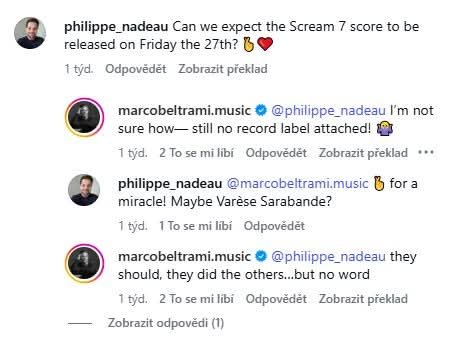
-
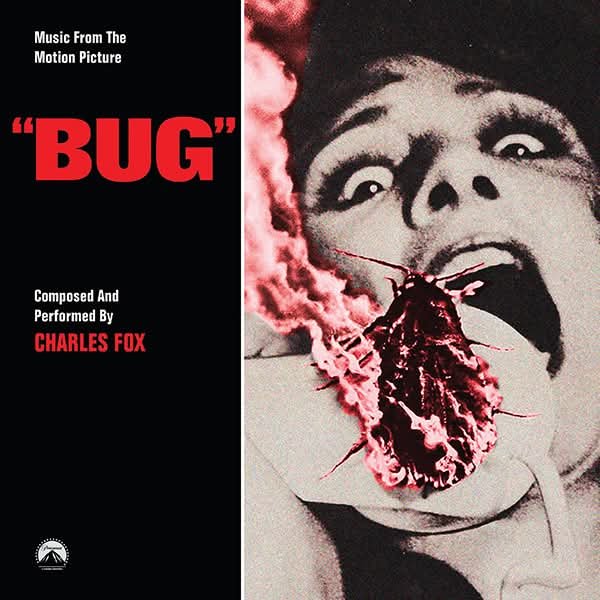
veröffentlichung Intrada: BUG (Charles Fox)
Alexander Grodzinski antwortete auf Alexander Grodzinskis Thema in Scores & Veröffentlichungen
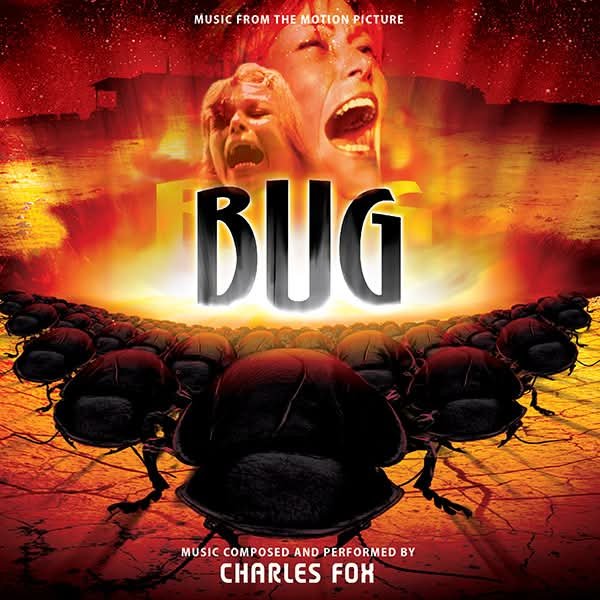
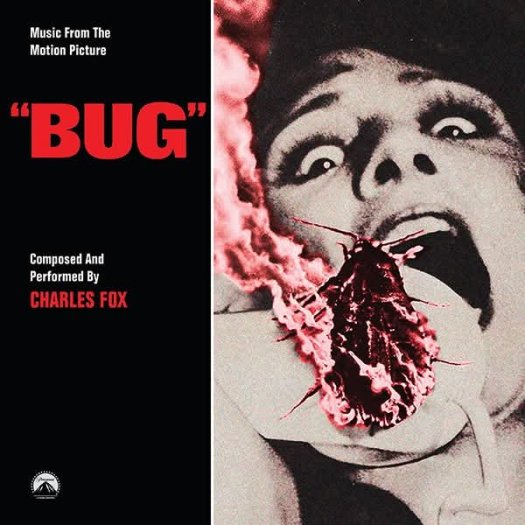
Intrada announces a unique score from composer Charles Fox for the Paramount sci-fi horror film Bug. While Fox is often known for his melodic and effervescent style of scoring, this project offered an opportunity to provide a stark contrast to his usual trademark sound. The score is entirely performed on the Moog synthesizer, the only one in the composer's output. Fox was among the first composers to purchase a Moog directly from its creator. “It was so new that there was no instruction manual yet. It came with 13 oscillators for sounds, and you just had to figure it out!” he remarked. The result is a score that is unmistakably computer-like with percussive motifs that vividly convey 1970s state-of-the-art blinking buttons, whirling tapes and screen displays spinning out information. Except in this film the thinking machines working and evolving in tandem are the roaches. It’s this cutting-edge sound (at the time) that puts Bug in worthy experimental company along side Gil Mellé’s high-tech synth approach to his score for The Andromeda Strain. The atonality of the score is profound, leading Fox to recommend to Intrada that "there should be an advisory with the score that it not be played at a dinner party." But check it out for yourself in this trailer. The album was produced by Dan Goldwasser, mastered by Doug Schwartz, and features liner notes by Daniel Schweiger. In the film, a series of earthquakes releases a species of ancient cockroaches from deep underground. These insects have an unusual ability to ignite fires through a chemical reaction in their bodies. As the bugs multiply and begin causing deadly fires, a college entomologist, Dr. James Parmiter, studies them and discovers they may be evolving rapidly and developing a form of intelligence. His obsession with understanding and controlling the creatures ultimately leads to dangerous consequences as the situation spirals out of control. THE SCORE 01. Trail Of Fire (0:50) 02. The Bugged Pick-Up (1:30) 03. The Fiery Feline (1:57) 04. Discovery At The Chasm** (3:15) 05. A Shocking Discovery** (0:56) 06. Jarring The Roaches (2:47) 07. A Ring Of Terror* (1:56) 08. Killing The Killer (1:45) 09. They Will Die (0:57) 10. The Cake Box Roach/Human Inferno (2:38) 11. Death Row (2:08) 12. The Roach And The Egg Sack/The Roach Bridge* (0:29) 13. The Birth Of A New Strain (0:58) 14. The Deadly Offspring (1:48) 15. Man-Eating Roaches** (3:49) 16. The Wall Of Terror** (3:17) 17. Into The Chasm (1:07) 18. Terror In The Night** (5:20) 19. End Credits** (1:18) Total Score Time: 38:45 THE EXTRAS 20. Bug Logo (Unused Title Sting, 3 Versions) (0:27) 21. Trail Of Fire (Alternate Take) (0:48) 22. The Bugged Pick-Up (Alternate Tag) (0:17) 23. Jarring The Roaches (Alternate Mix) (2:46) 24. They Will Die (Alternate Mix) (0:59) 25. The Roach Bridge (Alternate) (0:09) 26. The Deadly Offspring (Alternate Take) (1:47) 27. Into The Chasm (Extended Alternate) (3:18) 28. End Credits (Short Version) (0:50) Total Extras Time: 11:21 Total CD Time: 50:06 * not used in film **contains material not used in film -
LLL hat normalerweise nur die Lizenz für die physischen Veröffentlichungen. Die Streaming-Lizenzen bleiben meist beim Rechteinhaber. Und der entscheidet dann, ob die Musik auch auf den einschlägigen Streaming-Portalen erscheint. Es gibt ein paar Ausnahmen, das war dann ein spezieller Deal. Wenn ich mich recht erinnere, konnte LLL beispielsweise auch einen der Transformers-Scores, den sie auf CD gebracht haben, auf die Streaming-Portale bringen. Oder es läuft eben über den Rechteinhaber, wie beispielsweise Amazon.
-
Snow Files of the Week: "The New Life/Resolution", aus dem TV-Film "Oldest Living Confederate Widow Tells All" (1994). Dieser Score ist ein weiterer Beweis dafür, dass Mark durchaus mit einem Orchester umgehen kann. Seine schwelgerischen Melodien und ein zauberhaftes Hauptthema für Solo-Violine machen den Score zu einem schönen Hörerlebnis. Der Score wurde 1994 von Milan Records auf CD veröffentlicht. Viel Spaß beim Hören!
-
Ebenfalls neu von Quartet: Quartet Records, in collaboration with MovieScore Media, presents a new score by the renowned Academy-Award winner composer Stephen Warbeck (SHAKESPEARE IN LOVE, QUILLS, BILLY ELLIOT, THE MAN IN THE HAT) for a film directed by Gaby Dellal. Starring Fiona Shaw and Katherine Waterston, the story is about Charlotte, who—paralyzed by her life as a cattle rancher—flees her controlling husband and returns to her mother’s apartment. There, she rediscovers her teenage love and the life she left behind. Now, mother and daughter must confront hidden truths. Stephen Warbeck’s music for PARK AVENUE is conceived as an intimate and slightly eccentric score, always remaining within the emotional range of the story. The recording features an ensemble made up of a combination of musicians from both jazz and classical music, giving the score a hybrid texture and diverse interpretive sensibility, with performances by double bassist Lars Danielsson and cellist Nick Cooper standing out. Black Sun 1:56 (Performed by Isaac Waddington) The Chase 1:31 The Reckoning 2:16 New York 2:20 Central Park 1:53 Kit’s World 2:48 Waiting 1:31 The Gallery 1:13 Manhattan Bar 1:03 Living and Dying 2:17 In the Bar 1:58 Park Avenue 1:50 The Awakening 1:58 The Gurney 1:53 Charlotte Leaving 1:47 The Poem and the Truth 5:13 The Hospital 1:45 Mother and Daughter 2:15 The Closing 3:06 Sweet Jane 2:06. (Performed by Mathilda Florence)
-
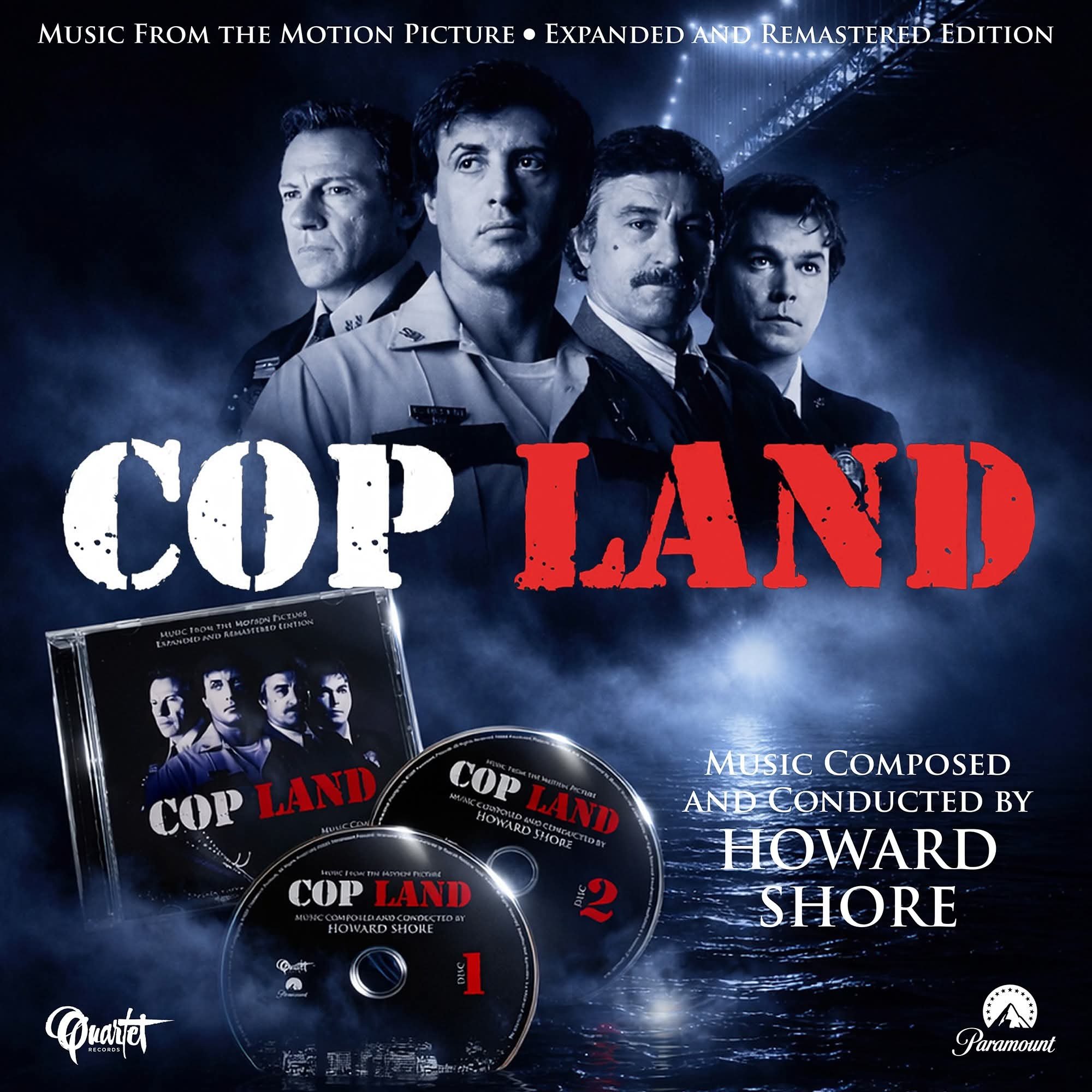
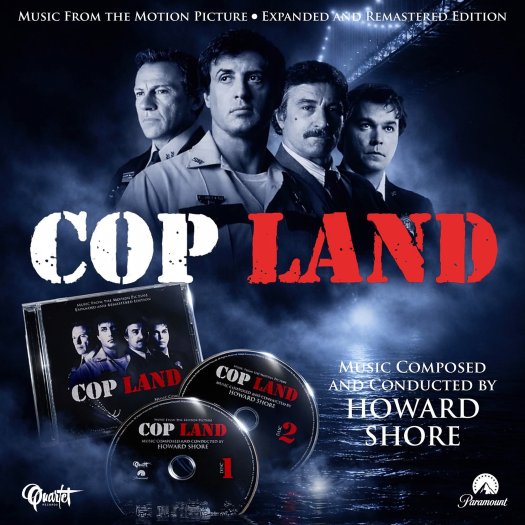
Quartet Records, in collaboration with Paramount Pictures, presents a remastered and expanded 2-CD deluxe edition of COP LAND, the cult soundtrack composed by Howard Shore in 1997 during one of the most creative periods of his career, following such classic scores as THE SILENCE OF THE LAMBS, SEVEN, M BUTTERFLY, ED WOOD, CRASH and LOOKING FOR RICHARD, among many others. Written and directed by James Mangold, the film features an impressive cast, including Sylvester Stallone, Robert De Niro, Harvey Keitel and Ray Liotta. Stallone plays a sheriff in a suburban New Jersey community populated by New York City police officers, who slowly discovers that the town is a front for mob connections and corruption. Howard Shore composed a dramatic and intense score with fatalistic, heroic and emotional elements, showcasing his ability to elevate human conflicts to epic proportions through music. The score for COP LAND was released on a 40-minute album by Milan Records in 1997, but it was far from complete. It strangely omitted the powerful and robust music composed for the end credits (“Back to Work” on our album), one of Shore’s most impressive compositions. The re-editing of the film and changes in the studio criteria led Shore to rewrite and adapt a large part of his score, of which an additional 30 minutes or so can be found in the bonus tracks section on the second disc. The original album included unique mixes and edits, so we have kept it intact and remastered. Performed by the London Philharmonic Orchestra under the composer’s baton, this album has been painstakingly produced by Dan Goldwasser, mixed and mastered by Chris Malone, and entirely supervised and approved by Mr. Shore. The package includes an in-depth essay by film music writer Jeff Bond. DISC 1. THE FILM SCORE Cop Land 1:14 Discovering Frankie 1:19 Tunnel to the Bridge / Across the River 2:35 George Washington Bridge 4:33 Interrogation / Ray Pulled Over / Cupcake 1:32 Turtle Ride 0:58 Garrison, NJ (Film Version) 1:35 Liz 1:09 Connecting With Liz 1:46 Figs in Bar 2:59 Dream and Death 3:05 Funeral 0:57 $64,000 Question 3:43 Mashed Potatoes Don’t Mean Gravy (Film Version) 2:06 Closed Case 1:33 I’m Ghandi 1:31 Pool of Crimson (Film Version) 4:02 Chasing After Babitch 1:49 Change of Heart 2:22 Offered a Chance 0:48 Stealing the Files 4:40 Five Out of Six 1:15 Lagonda in the Backseat 1:29 Check 0:49 Tracking the Bomb 1:22 Big Blue Pow Wow (Film Version) 4:20 Kidnapped 1:04 All Dressed Up in Blue (Film Version) 4:19 One Police Plaza (Film Version) 2:18 Back to Work 5:09 Total Disc Time: 68:33 DISC 2. THE ORIGINAL 1997 SOUNDTRACK ALBUM All Dressed Up in Blue 4:21 Garrison, NJ 1:47 Yellow Betray Blue 3:33 Local Boy Saves Drowning Teen 3:05 Mashed Potatoes Don’t Mean Gravy 2:25 The Sheriff of Cop Land 2:39 Pool of Crimson 4:40 The Diagonal Rule 4:27 Across the River 4:59 Big Blue Pow Wow 2:31 Without Looking at the Cards 4:07 One Police Plaza 2:07 Cop Land (Alternate) 1:11 Across the River (Early Version) 0:34 Across the River (Solo French Horn Alternate) 0:34 George Washington Bridge #1 2:15 George Washington Bridge #2 2:12 Ray Pulled Over (Alternate) 0:37 Turtle Ride (Alternte) 0:57 Funeral (Alternate) 0:39 Closed Case (Alternate) 1:35 Chasing After Babitch (Alternate) 1:48 Offered a Chance (Alternate) 0:48 Five Out of Six (Early Version) 1:09 Five Out of Six (Alternate) 1:14 Check (Early Version) 0:51 Check (Alternate) 0:48 One Police Plaza (Early Version) 1:49 One Police Plaza (Alternate) 1:49 Back to Work (Alternate) 1:07 Bagpipes 1:03 Cop Land Jazz Grouping 1:06 Freddy Directing Traffic (Bonus) 1:02 Total Disc Time: 66:28 Total Collection Time: 135:01
-
Müssen nicht immer die Rechte sein. Es können auch einfach noch nicht alle Freigaben da sein. Wie schon öfter erwähnt, müssen auch die verwendeten Fotos für das Artwork freigegeben werden. Dazu müssen unter Umständen auch die gezeigten Darsteller oder deren Vertretung kontaktiert werden. Und bis von da eine Antwort kommt, kann auch dauern.
-
Am 9. März:
-
veröffentlichung Intrada: BUG (Charles Fox)
Alexander Grodzinski erstellte ein Thema in Scores & Veröffentlichungen
Am 10. März von Intrada: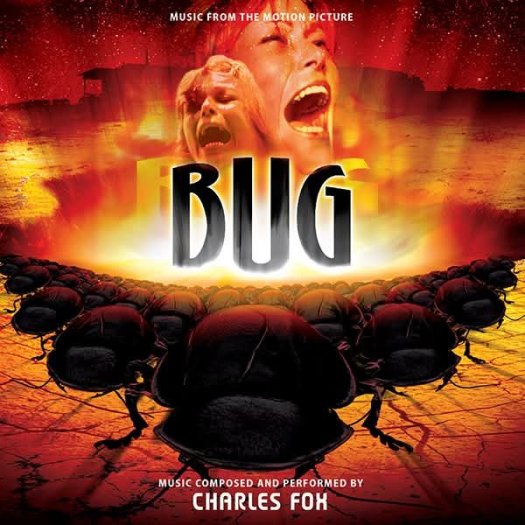
-
Music by Mark Mancina Limited Edition of 3000 Units STARTS SHIPPING MID-MARCH La-La Land Records and Sony Pictures celebrate the 30th Anniversary of the 1995 blockbuster big-screen action/comedy BAD BOYS, starring Will Smith and Martin Lawrence, and directed by Michael Bay, with this remixed, remastered and expanded limited edition 2-CD re-issue of acclaimed composer Mark Mancina’s iconic original motion picture score. Mark Mancina’s (SPEED, TWISTER, TARZAN) exhilarating action score to the film SPEED established the composer as a fresh and notable musical voice, making him the perfect choice for BAD BOYS, a bold and exciting new take on the battle-tested buddy-cop/action formula. Mancina expertly harnesses superstars Will Smith and Martin Lawrence’s explosive comedic and dramatic chemistry, along with Director Michael Bay’s high-octane action mayhem, creating a legendary work that helped change and influence action film scoring into the 21st century and one that still serves as the musical thematic foundation of the entire BAD BOYS franchise decades later. La-La Land’s original 2007 single disc CD release of BAD BOYS was compromised by the only available music elements at that time, resulting in some of that release’s program in mono. Now presented in full stereo for the first time, this all-new remastered and expanded 2-CD re-issue is a major upgrade in both sonic quality and content, finally allowing Mancina’s work to shine in all its brilliance! Produced by Stéphane Humez and mixed and mastered by Maxime Marion from newly discovered 32-track digital masters, this deluxe presentation of BAD BOYS features the film score presentation on Disc One and Bonus Tracks on Disc Two. Limited to 3000 Units, this release’s exclusive liner notes are by writer Kaya Savas and include new interviews with composer Mark Mancina and additional composer Nick Glennie-Smith. The sharp art design is by Dan Goldwasser. TRACK LISTING: DISC 1 SCORE PRESENTATION 1. Funky Logo – Car Jacking 3:39 2. Bad Boys Main Title – The Heist* 6:11 3. Funky Brothers To P.D. 0:38 4. Air Conditioning Inspection* 1:09 5. Jojo What You Know 0:41 6. Dead Guy 5:14 7. He’s The Person I’d Call* 0:55 8. Killing Max 4:18 9. The Boys Find Max 1:34 10. Into Lois’ Apartment 1:11 11. Max Logan’s Best Friend 0:53 12. Escape From Julie’s 2:48 13. You’re Going To Leave Me Alone? 0:54 14. Don’t “Honey Baby” Me 1:04 15. My Bologna Has A First Name* 3:59 16. Julie’s Got A Gun 0:42 17. Escape From Club Hell – Ether Chase* 4:36 18. We Don’t Want To Lose You 0:41 19. I Mean Like Funny 2:13 20. Stake Out – Interrogation 1:26 21. Tailing Lab Tech – Blown Cover 1:39 22. Busted* 1:00 23. Footchase 4:25 24. Fouchet Calling* 0:35 25. Hangar Shootout* 9:17 26. Cobra Chase 1:47 27. Fouchet’s Death 3:03 TOTAL DISC TIME 66:30 DISC 2 BONUS TRACKS 1. Theme From Bad Boys 4:15 2. Funky Brothers To P.D. (Demo Version) 0:29 3. Jojo What You Know (Film Version) 0:34 4. Dead Guy (Alternate) 3:35 5. The Boys Find Max (Alternate Version 1) 1:23 6. The Boys Find Max (Alternate Version 2) 1:24 7. Escape From Julie’s (Demo Version) 2:47 8. My Bologna Has A First Name (Alternate) 4:05 9. Escape From Club Hell (Demo Version)* 1:53 10. Escape From Club Hell (Film Version)* 2:01 11. Footchase (Demo Version) 4:24 12. Fouchet Calling (Alternate)* 0:35 13. Fouchet’s Death (Alternate) 3:03 14. Theme From Bad Boys (Funky Boys Remix) 5:38 TOTAL DISC TIME 36:08 TOTAL ALBUM TIME 1:42:38 * Written by Mark Mancina & Nick Glennie-Smith This is a CD format release
-
Music by Trevor Rabin Limited Edition of 2000 Units La-La Land Records and Sony Pictures proudly present the official world premiere 2-CD limited edition release of renowned composer Trevor Rabin’s (ARMAGGEDON, DEEP BLUE SEA, NATIONAL TREASURE) original motion picture score to the 2003 blockbuster big-screen action/comedy BAD BOYS II, the first sequel in the powerhouse BAD BOYS franchise, starring Will Smith and Martin Lawrence, and directed by Michael Bay. The long-awaited re-teaming of Will Smith, Martin Lawrence and Michael Bay for BAD BOYS II would notably up the scope, scale and action of the original film and composer Trevor Rabin rises to the challenge with a breathtaking behemoth of an action score. Teeming with propulsive original material and themes, Rabin unleashes all-new musical adrenaline, with subtle nods honoring BAD BOYS composer Mark Mancina’s original main theme. This 2-CD deluxe presentation marks the first official release of Rabin’s BAD BOYS II in any format! Produced by Stéphane Humez and edited and mastered by Maxime Marion from studio vault elements, this deluxe presentation of BAD BOYS II features the film score presentation, including additional score by Steve Jablonsky on both CDs, while a massive bounty of Bonus Tracks is featured on Disc Two, including Mark Mancina’s unused demo for this sequel – a rearrangement of his original, iconic BAD BOYS theme! Limited to 2000 Units, this release’s exclusive liner notes are by writer Kaya Savas and the sharp art design is by Dan Goldwasser. TRACK LISTING: DISC 1 SCORE PRESENTATION 1. Xtreme Machine*** 4:19 2. Swamp – KKK++ 5:29 3. Tapia 0:35 4. Money Counting* 1:11 5. Haitian Saddle Up+ 0:49 6. Syd Getaway – Muscle Car* 4:10 7. Shootout§§ 2:47 8. Causeway* 4:12 9. Syd And Mike** 1:33 10. Pressure Points* 0:29 11. Tapia Pissed Off 1:07 12. Ice Pick** 0:49 13. Haitian Shootout+ 3:45 14. Rat Porno°°° 0:25 15. Tapia Conversation – Escape Tapia’s 4:11 16. Tapia Threatens – Computer Lab* 0:34 17. Wiretap Results 1:01 18. Tapia And Syd Ocean 1:39 19. Stilt House* 2:17 20. Boat Dock – Follow The Cubans+++ 2:48 21. Cuban – Van Chase* 4:32 22. Train Fight 2:23 23. Bad Boys For Life 0:38 24. Mortuary Sneak 1:38 25. Escape Mortuary° 3:24 26. Syd’s Cover Is Blown 5:45 27. Tapia Has Syd°° 5:31 TOTAL DISC TIME 68:00 DISC 2 SCORE PRESENTATION CONTINUED 1. Prepare For Tapia*** 0:52 2. Tapia Attack§§ 9.03 3. Cuba Chase 3:23 4. Guantanamo 1:56 BONUS TRACKS 5. Theme From Bad Boys (Bad Boys II Demo Version)** 2:37 6. Xtreme Machine (Alternate)*** 2:45 7. Syd Getaway – Muscle Car (Alternate)* 4:10 8. Shootout (Alternate)§§ 3:05 9. Causeway (Alternate)* 4:23 10. Pressure Points (Alternate)* 0:29 11. Tapia Conversation (Alternate) 3:17 12. Bad Boys For Life (Alternate) 0:38 13. Mortuary Sneak (Alternate) 1:08 14. Tapia Has Syd (Alternate Version 1) 5:19 15. Tapia Has Syd (Alternate Version 2) 5:27 16. Tapia Has Syd (Alternate Version 3) 2:20 17. Tapia Has Syd (Helicopter Insert)* 1:19 18. Tapia Attack (Alternate Beginning) 3:33 19. Cuba Chase (Alternate) 3:22 20. Guantanamo (Alternate Version 1) 2:09 21. Guantanamo (Alternate Version 2) 2:11 22. Menina§ 4:05 TOTAL DISC TIME 67:29 TOTAL ALBUM TIME 2:15:29 * Written by Steve Jablonsky ** Written by Mark Mancina *** Written by Paul Linford + Written by Harry Gregson-Williams ++ Written by Trevor Rabin & Mark Mancina +++ Written by Mark Mancina, Steve Jablonsky & Trevor Rabin ° Written by Steve Jablonsky, Mark Mancina, Tim Heintz & Trevor Rabin °° Written by Trevor Rabin, Steve Jablonsky & Tim Heintz °°° Written by Trevor Rabin & Paul Linford § Written by Heitor Pereira §§ Contains an Interpolation of “Theme From Bad Boys” Written by Mark Mancina These are CD format releases.
-
Snow Files of the Week: "Damascus/The Subject", aus "MillenniuM", Episode "Owls" (1998). Als Mitglieder der MillenniuM-Gruppe in einer Moschee in Damaskus ein Stück Holz finden, welches zu dem Kreuz gehörte, an dem Jesus gestorben ist, entzweit sich die Gruppe in zwei Parteien: die "Eulen" und die "Hähne". Während die "Eulen" nicht an die Apokalypse mit dem Jahr 2000 glauben, sondern daran, dass das Jahr 2000 nur der Start von kosmischen Ereignissen ist, die erst knapp 60 Jahre später Auswirkungen haben werden, sind die "Hähne" davon überzeugt, dass das Ende nahe ist. Noch komplizierter wird es, als eine dritte Partei hinter dem Stück Holz her ist: das Projekt „Odessa", welches einst von den Nazis ins Leben gerufen wurde, um auf der ganzen Welt nach religiösen und machtvollen Objekten zu suchen. Marks Musik untermalt nicht nur die Szenen in Damaskus, als die Mitglieder der Gruppe sich wegen des Stück Holzes gegenseitig töten, sondern gibt der Folge auch eine religiöse Tonalität in dem Stück „The Subject". Diese Tracks stammen vom ersten Set mit MillenniuM-Musik von LLL, welches 2008 veröffentlicht wurde. Die erste Auflage war auf 2.000 Stück limitiert und war 2010 dann ausverkauft. 2015 wurde das Set wieder aufgelegt, dieses Mal limitiert auf nur noch 1.000 Stück. Auch diese Auflage ist ausverkauft. Viel Spaß beim Hören!
-
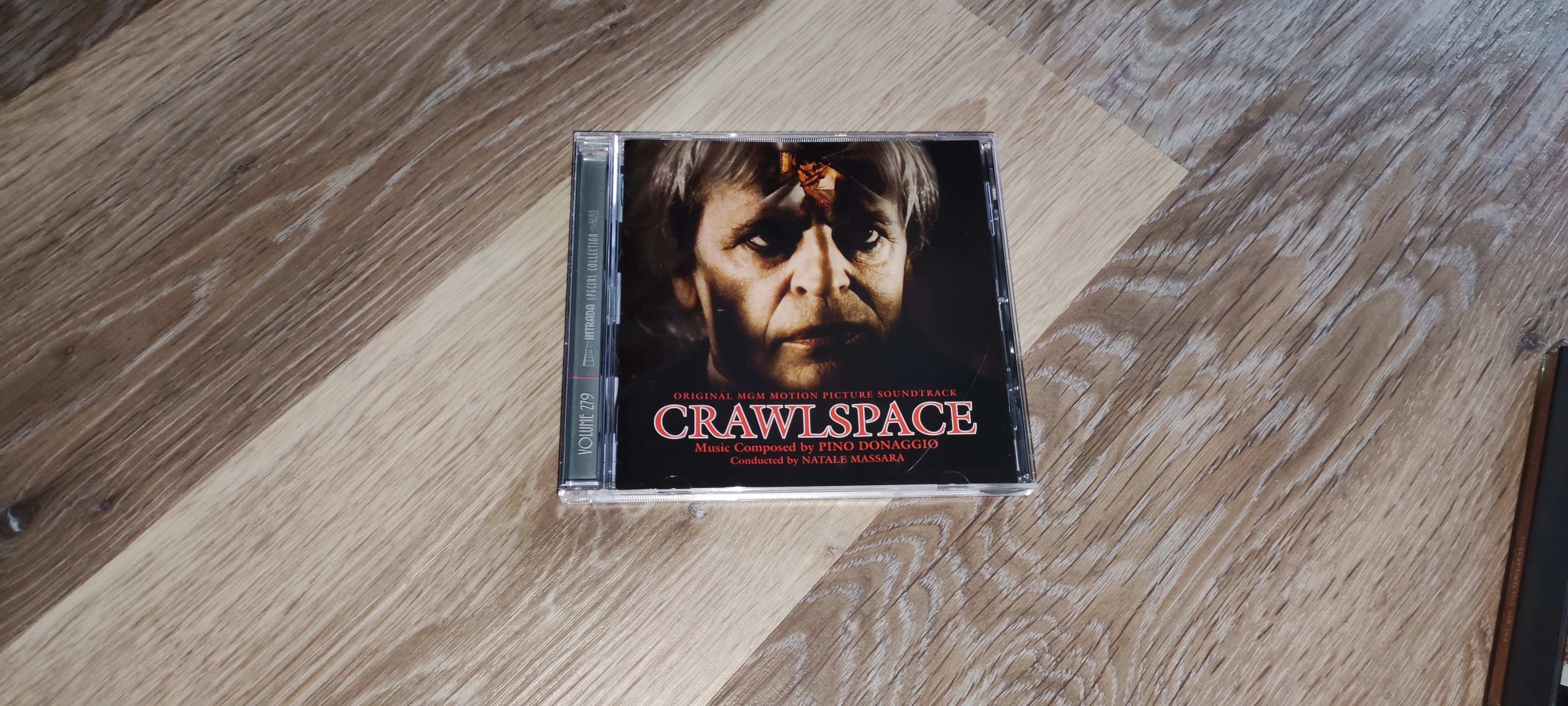
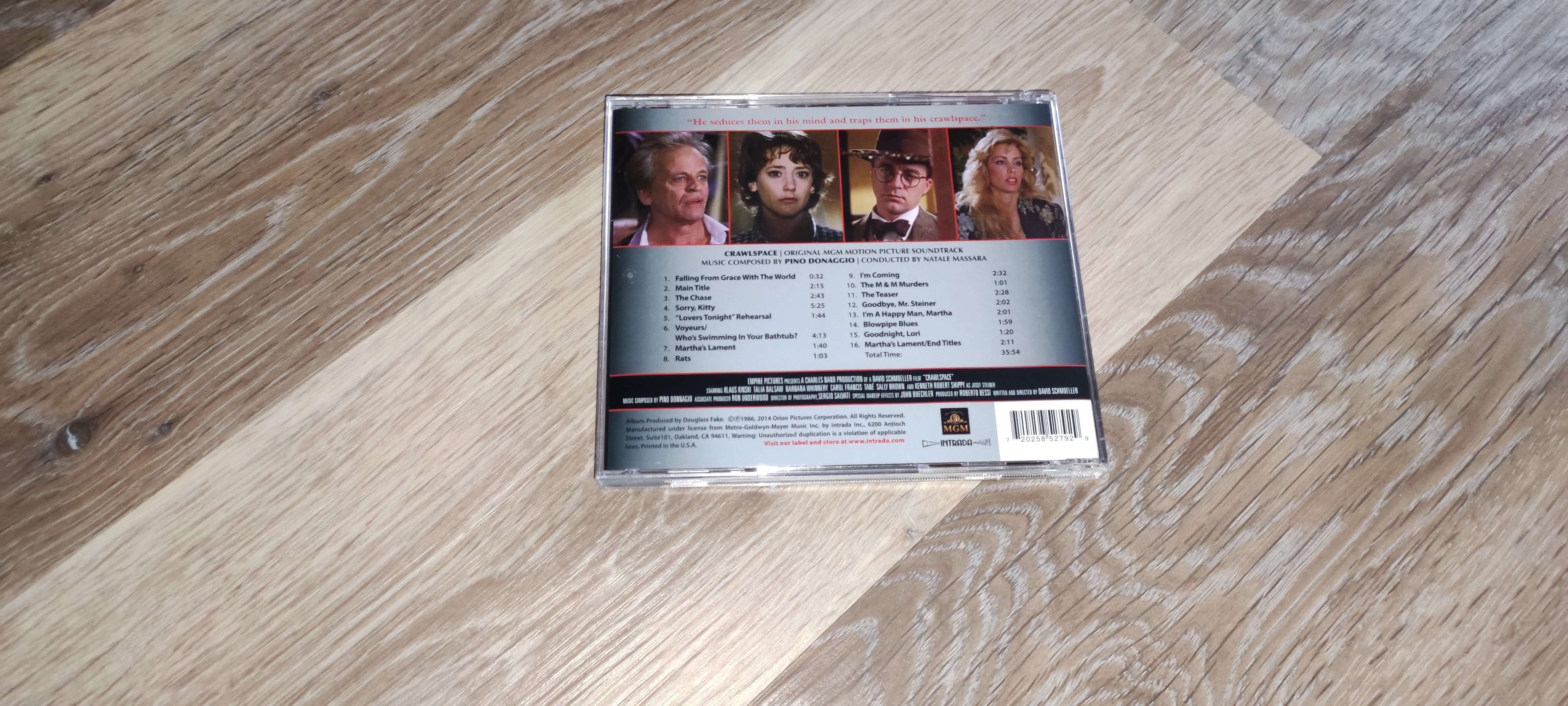
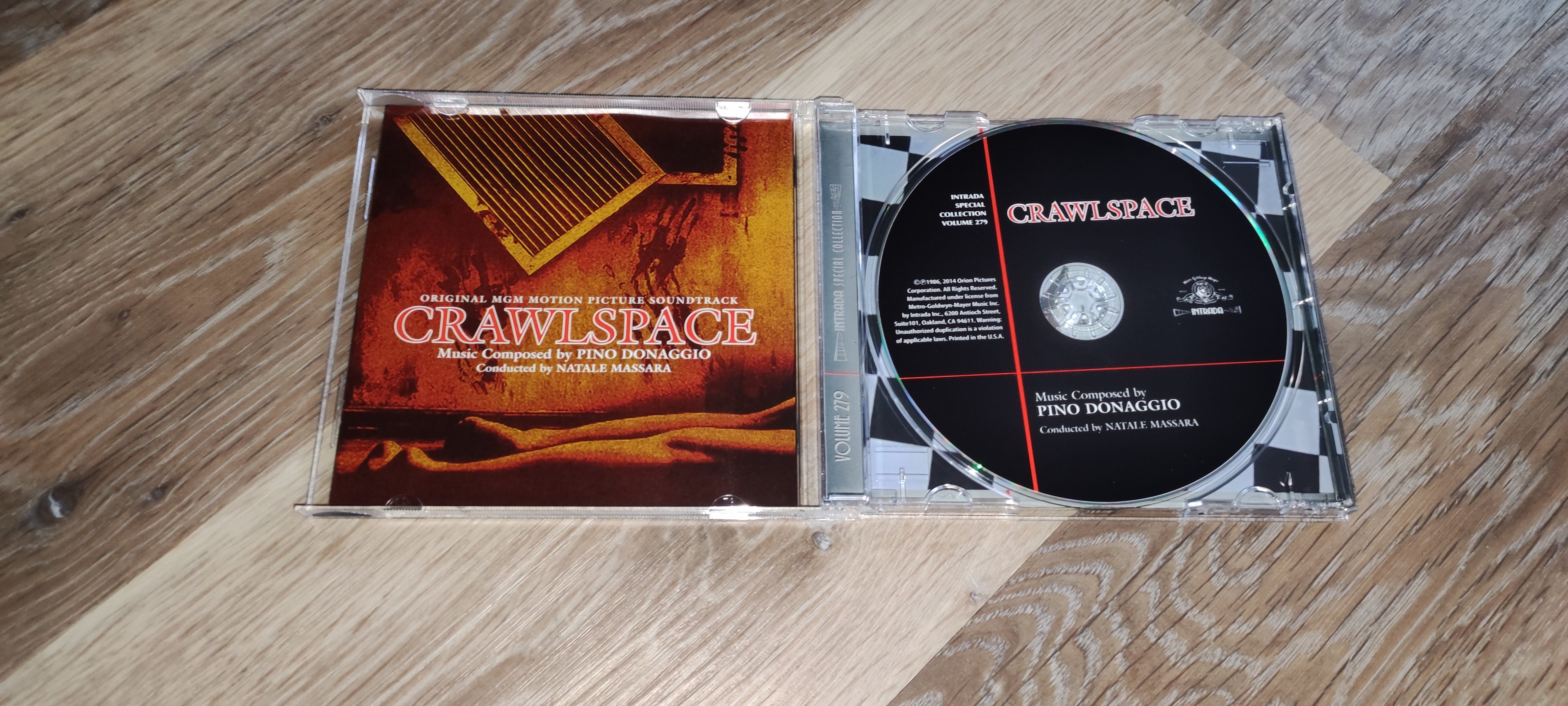
Pino Donaggio - Crawlspace (Intrada)
Alexander Grodzinski antwortete auf Alexander Grodzinskis Thema in Flohmarkt
Und weg -
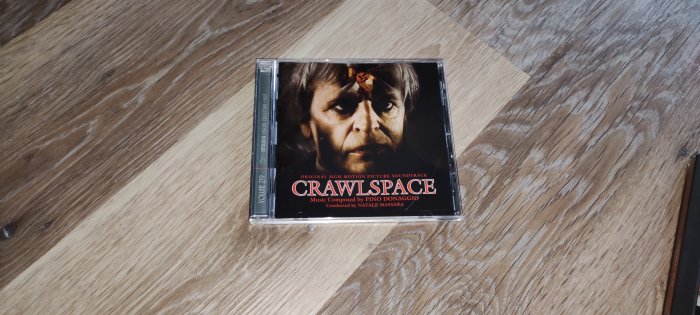
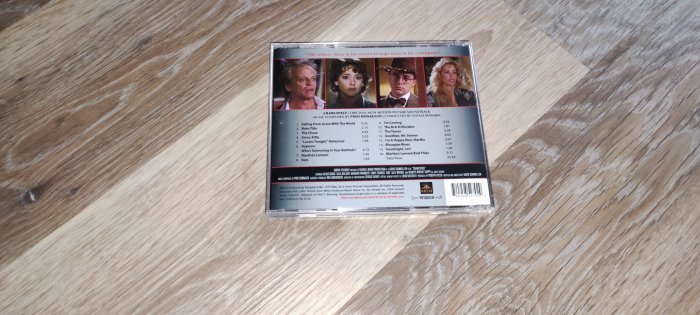
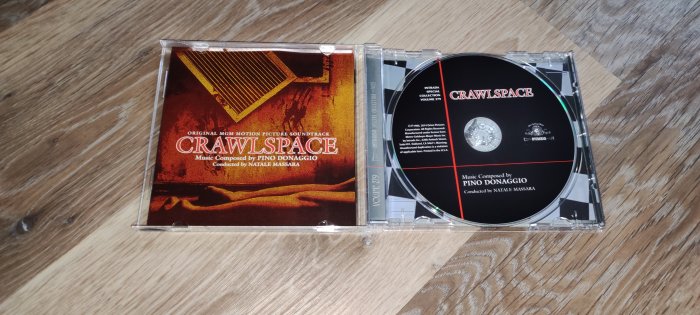
Ich verkaufe die Intrada-CD von Donaggios CRAWLSPACE für 19 Euro inklusive Versand. Bei Interesse gerne melden.
-
Neu von Dragon's Domain: Dragon’s Domain Records presents NORTH BY NORTHWEST, featuring music from the original motion picture score composed by Bernard Herrmann (CITIZEN KANE, NORTH BY NORTHWEST, VERTIGO) for the 1959 thriller directed by Alfred Hitchcock, written by Ernest Lehman, starring Cary Grant, Eva Marie Saint, James Mason, Martin Landau, Jessie Royce Landis, Leo G. Carroll, Philip Ober, Adam Williams, Edward Platt and Robert Ellenstein. Released on vinyl by Starlog Records in association with Varese Sarabande and also by Unicorn-Kanchana in Europe, later an early compact disc when the format was new, this recording featured a selection of music from the original motion picture score conducted by Laurie Johnson, performed by the London Studio Symphony Orchestra. At the time of the album’s inception in 1979, it was decided not to use the original 1959 tapes from the movie and to instead create a new stereo recording using the latest state-of-the-art technology of the day. The Sony PCM-1600 digital recording system and the Calrec Soundfield microphone were used together for the first time with a full orchestra for this recording. NORTH BY NORTHWEST was recorded direct to Sony digital in London on November 20, 1979. In addition to this recording, Laurie Johnson’s talents are represented on several other discs. As a tribute to Bernard Herrmann, Laurie adapted Herrmann’s original score to the horror film IT’S ALIVE and conducted it for the sequels, IT’S ALIVE 2 and IT’S ALIVE III: ISLAND OF THE ALIVE. Together with his partners Albert Fennell and Brian Clemens, Johnson owned the companies which produced the enormously successful TV series, THE NEW AVENGERS and THE PROFESSIONALS. Bernard Herrmann is one of the greatest composers of motion picture music in the twentieth century. He is considered the man behind some of the most original and distinctive film scores. He was a master at evoking psychological and dramatic tension in his music to suit the dramatic needs of a film. He won his only Oscar in 1947 for writing the score for THE DEVIL AND DANIEL WEBSTER. Herrmann made a powerful mark in radio and in 1934 he began a 25-year career as a conductor and composer in radio, working for the CBS. In 1938, he scored the notorious infamous presentation of Orson Welles’ Halloween production of H. G. Wells’ THE WAR OF THE WORLDS broadcast. He is best remembered for his collaborations with some of Hollywood’s most celebrated film directors like Alfred Hitchcock, Orson Welles, Martin Scorsese and Brian DePalma. Described as a perfectionist, he believed that most directors didn't have a clue about music so he would blithely ignore their instructions. His filmography includes CITIZEN KANE, THE MAGNIFICENT AMBERSONS, NORTH BY NORTHWEST, VERTIGO, MYSTERIOUS ISLAND, CAPE FEAR, FAHRENHEIT 451, OBSESSION, TAXI DRIVER and many hours of episodic television including THE TWILIGHT ZONE and HAVE GUN, WILL TRAVEL, among others. Dragon’s Domain Records is excited to bring this recording of NORTH BY NORTHWEST back to the marketplace, under license from Unicorn-Kanchana, newly remastered by James Nelson at Digital Outland and retaining the original album liner notes by Christopher Palmer. NORTH BY NORTHWEST presents, for the first time together, the 1979 original remastered stereo recording, followed by the one stereo microphone performance. NORTH BY NORTHWEST Is a limited edition release. NORTH BY NORTHWEST will begin shipping the week of March 2nd, 2026 Analog Multi-Track Stereo Remix 01. Main Title (3:20) 02. Kidnapped (1:59) 03. The Elevator (1:27) 04. Murder At The U.N. (3:17) 05. Conversation Piece (4:25) 06. The Crash (2:06) 07. The Auction & The Airport (2:13) 08. The Cafeteria / The Shooting (2:14) 09. Duo (1:28) 10. The Ledge / The House (4:25) 11. The Match Book (1:51) 12. The Airplane / The Stone Faces / The Ridge / On The Rocks / The Cliff / Finale (9:09) Original Calrec Soundfield - Stereo Microphone Mix 13. Main Title (3:18) 14. Kidnapped (2:00) 15. The Elevator (1:28) 16. Murder At The U.N. (3:19) 17. Conversation Piece (4:27) 18. The Crash (2:07) 19. The Auction & The Airport (2:14) 20. The Cafeteria / The Shooting (2:06) 21. DUO (1:31) 22. The Ledge / The House (4:27) 23. The Match Book (1:50) 24. The Airplane / The Stone Faces / The Ridge / On The Rocks / The Cliff / Finale (9:09) Total Time: 76:02 Dragon’s Domain Records presents the world premiere release of the soundtrack for THE COWBOY AND THE BALLERINA, featuring music composed by Bruce Broughton (SILVERADO, TOMBSTONE, THE ORVILLE ) for the 1984 television film directed by Jerry Jameson, written by Denne Bart Petitclerc and starring Lee Majors, Leslie Wing, Christopher Lloyd, James Booth, Antoinette Bower, George De La Pena, Steven Ford, Anjelica Huston, John McIntire and Severn Darden. Airing on television in October 1984, THE COWBOY AND THE BALLERINA offered actor Lee Majors the chance to take a break from his second hit television series, THE FALL GUY, to star in this romantic film. THE COWBOY AND THE BALLERINA follows Clay Clayton (Majors), a former world champion bronco rider as he becomes involved with Natalia (Wing), a Russian ballerina who is desperate to flee her Soviet touring company and reunite with her mother who is living in New York City. On their journey, Clay and Natalia must outwit two agents (Booth, Huston) who are determined to see that she doesn’t defect. As the principle theme of the film is a romance born of a clash between people from extremely different cultures, composer Bruce Broughton had to expertly weave their two thematic motifs together. While the music representing Clay’s down-to-earth Western life and persona is played with atypical instruments, piano, guitar and fiddle, Natalia's music has a more sophisticated orchestral sound. Bruce Broughton, who has won ten Emmy Awards and been nominated for an Oscar, began his journey into film music in 1973, scoring episodes of television shows from GUNSMOKE, HAWAII FIVE-0, and DALLAS to JAG and THE ORVILLE, miniseries like THE BLUE AND THE GREY and THE OLD MAN AND THE SEA, and feature films such as SILVERADO, YOUNG SHERLOCK HOLMES, HARRY AND THE HENDERSONS, TOMBSTONE, and HONEY, I BLEW UP THE KID. Broughton has more than 130 scores to his credit. Throughout his career, Broughton has amassed ten Emmy Awards (from twenty-three nominations) and an Academy Award nomination (SILVERADO). In addition to being a composer and an accomplished conductor, Broughton is also a tireless educator having taught classes at the UCLA Herb Alpert School of Music, the Department of Screen Scoring at the USC Thornton School of Music, and is currently serving as Media Composer-in-Residence at the University of North Texas. Dragon’s Domain Records presents the world premiere release of THE COWBOY AND THE BALLERINA, featuring music composed and conducted by Bruce Broughton. The music has been mastered by James Nelson at Digital Outland and the liner notes have been written by author David Hirsch. THE COWBOY AND THE BALLERINA is a limited edition release. The first 50 copies will be autographed by the composer. THE COWBOY AND THE BALLERINA is expected to begin shipping the week of March 2nd, 2026. 01. Opening Titles (2:40) 02. Natalia At Airport / Switching Outfits (3:06) 03. Hiding In Clay's Bronco (2:45) 04. Avoiding Security / Driving Montage A / Clay Tames The Horse (4:14) 05. Remembering Victoria / Horseback Riding (3:13) 06. Natalia’s Story / Love In The Haystacks (3:23) 07. Leaving Doc’s Ranch / Driving Montage B / Caviar Picnic (2:19) 08. Arriving In New York / Woody and Natalia In Alley (3:41) 09. Advice From Woody / Natalia Calls Her Mother / Tailed Again / Good Night / Natalia Returns / Love Scene (4:54) 10. Clay and Natalia Are Followed / The Beach House / Natalia Leaves Rodeo (3:28) 11. The Finale and End Credits (4:38) 12. Bumpers (0:19) 13. Country Bar Source (2:03) 14. Bar Source (4:01) 15. Rodeo Sources (1:52) 16. Ballet Sources (2:46) 17. Reception Source (2:17) Total Time: 51:47 Dragon’s Domain Records presents THE LEE HOLDRIDGE COLLECTION, VOLUME 4, featuring music composed and conducted by Lee Holdridge (JONATHAN LIVINGSTON SEAGULL, SPLASH, BEAUTY AND THE BEAST) for two romantic scores from his extensive filmography. Airing in 1999, SEALED WITH A KISS is a romantic comedy directed by Ron Lagomarsino, written by Jeff Arch (SLEEPLESS IN SEATTLE, IRON WILL) and stars John Stamos, Annabeth Gish, Jane Sibbett, Mitchell Whitfield, Robert Stack, Nell Carter, Barry Corbin and Angie Dickinson. SEALED WITH A KISS, also released under the titles LOVE COMES FIRST and LONGFELLOW BRIDGE, follows Boston financial consultant Bennett Blake (Stamos), who is on the fast track to make partner while engaged to his equally career-driven boss’s daughter, Christina (Sibbet). Asked to travel to North Dakota to play golf with an oddball wealthy client, he’s warned that he must let the client win. Despite his best attempts to fail, he still achieves a hole-in-one, and the angry client pulls his business from the firm. When a letter meant for someone else is accidentally mailed to Bennett’s home, Christina urges Bennett to return the letter to Robbie (Gish). She’s a curator of a museum for the poet Longfellow and desperate for funding. At first, she mistakes Bennett for a Washington official bent on shutting the facility down. He finds himself drawn to the down-to-earth Robbie and decides to help save the museum by assembling a financial plan. Working with her, he discovers the need to reevaluate his own soul-less life. For SEALED WITH A KISS, Holdridge wrote a bubbly score featuring lush orchestrations, allowing the orchestra to boldly project the humorous undertones of Bennett and Robbie’s unplanned road to true love. Released in 1973, JEREMY is a teen romance written and directed by Arthur Barron, starring Robbie Benson, Glynnis O’Connor, Len Bari, Leonardo Cimino, Ned Wilson, Chris Bohn, Patricia Wheel and Ted Sorel. JEREMY follows Jeremy Jones (Benson), a shy, bespectacled, fifteen-year-old living in New York City who is studying cello at a private performing arts high school. One day, he meets Susan (O'Connor) as she is practicing ballet. Despite the fact that she is older and in a higher grade, he is instantly attracted to her. Jeremy attempts to talk to her, but he is too shy to do so. At a school recital where Jeremy plays as a featured soloist, she is impressed by his playing and congratulates him afterwards. This interaction motivates him to finally ask her out. On their first date, Jeremy finds out that Susan and her father have just moved to New York from Detroit so her father could take a new job. Over the next three weeks, their romance quickly intensifies as they spend a lot of time together. One rainy afternoon while playing chess in Jeremy’s room, the teens profess their feelings for each other and then make love for the first time. When she returns home, Susan’s father announces that he's been offered a better job back in Detroit, which means they have to leave New York immediately. By happenstance, Jeremy finds himself alone again... JEREMY is one of Lee Holdridge’s earliest film scores. The film won the prize for Best First Work at the 1973 Cannes Film Festival, and Benson was also nominated for a Golden Globe Award for his performance. Holdridge’s tender and powerful score for JEREMY is built partially around the film’s theme song but features several original emotional cues underscoring the teens’ attraction and eventual heartbreak. The cello, Jeremy’s chosen musical instrument, features prominently in several cues. Lee Holdridge was born in Port-au-Prince, Haiti in 1944. He spent his early years in Costa Rica, beginning music studies on the violin at the age of ten with Hugo Mariani, then the conductor of the National Symphony Orchestra of Costa Rica. Later, Holdridge moved to New York to continue his music studies and begin his professional career as a composer. Holdridge’s successes in New York came to the attention of Neil Diamond who brought Holdridge to Los Angeles to write arrangements for his forthcoming albums. A string of Gold and Platinum hits followed, which led to Diamond and Holdridge collaborating on the film score for JONATHAN LIVINGSTON SEAGULL. Since that time, Holdridge has scored numerous film such as SPLASH, BIG BUSINESS, MR. MOM, MICKI & MAUDE, 16 DAYS OF GLORY, SYLVESTER, A TIGER’S TALE, EL PUEBLO DEL SOL, OLD GRINGO, PASTIME and BROTHERS AT WAR. His television work include MOONLIGHTING, BEAUTY AND THE BEAST, the complete eight hour remake of EAST OF EDEN, DREAMER OF OZ, Hallmark Hall Of Fame’s ONE AGAINST THE WIND and THE STORY LADY. Lee also began a very successful collaboration with Moriah Films, the film division of the Simon Wiesenthal Center, with the Academy Award winning documentary feature film THE LONG WAY HOME. In addition to his film career, Mr. Holdridge has had an extensive repertoire of concert works performed and recorded. He has also worked with many major recording artists having written, arranged and conducted for Placido Domingo, Barbra Streisand, Brian May of Queen, Stevie Wonder, Neil Diamond, John Denver, Neil Sedaka, Daniel Rodriguez, Al Jarreau, Dionne Warwick, Diana Ross, Natalie Cole, Jane Oliver and many others. Dragon’s Domain Records is excited to bring SEALED WITH A KISS and JEREMY to compact disc for the first time as part of THE LEE HOLDRIDGE COLLECTION, VOLUME 4, mastered by James Nelson at Digital Outland. The booklet includes liner notes written by author David Hirsch. THE LEE HOLDRIDGE COLLECTION, VOLUME 4 is a limited edition release of 500 units. The first 50 copies will be autographed by the composer. THE LEE HOLDRIDGE COLLECTION, VOLUME 4 will begin shipping the week of March 2nd, 2026. SEALED WITH A KISS 1. Opening Title (2:17) 2. Going To Work / Let’s Play Golf / It’s Greek To Me / Make A Wish / Hole In One / State of Shock (4:12) 3. Two Seagulls / No Sex Tonight / Save Longfellow’s Home / Go Back To Washington (3:19) 4. Cocktail Party A (2:49) 5. Cocktail Party B / Out On The Balcony / Vodka Gimlet (2:27) 6. Wink’s Realization / Shrimp / Bennet's Jog / Starting Over / Late Night / Woman In The Rain (4:08) 7. Stop Pretending / Pet Rock / Twilight’s Coming / So Stay / Good Night (5:12) 8. A Second Chance / Robbie Leaves / Thinking of Her (4:38) 9. The Lowest Ebb / What I Want (2:19) 10. No Jerry Maguire / Cosmic Connection (2:08) 11. Duck L’Orange (Source) (1:38) JEREMY 12. Blue Balloon (The Hourglass Song) (4:23) Vocal: Robby Benson 13. Dating Montage (1:45) 14. Three Vignettes: (A) Jeremy’s Reflection, (B) Blue Balloon (The Hourglass Song) (Reprise), (C) The First Kiss (2:37) 15. Jeremy Follows Susan (2:03) 16. Jeremy’s Concert (2:42) 17. Jeremy (2:09) Vocal: Glynnis O'Connor 18. Jeremy (Reprise) (0:56) 19. Blue Balloon (The Hourglass Song Instrumental) (4:22) 20. Lessons and Long Walks (1:57) 21. Theme for Jeremy and His Cello (1st Movement of the Concertino for Cello and Strings) (3:56) Total Time: 62:06 Dragon’s Domain Records presents THE DON DAVIS COLLECTION, VOLUME 2 featuring the world premiere releases of VALENTINE and BLACKOUT, two horror films from the composer's extensive filmography. Released in 2001, VALENTINE is a dark comedy/horror film directed by Jamie Blanks, written by Tom Savage, Donna Powers and Wayne Powers, starring Denise Richards, David Boreanaz, Marley Shelton, Jessica Capshaw, Jessica Cauffiel, Katherine Heigl, Hedy Burress, Fulvio Cecere, Daniel Cosgrove, Johnny Whitworth, Woody Jeffreys and Adam Harrington. Based on the novel by Tom Savage, VALENTINE begins during a St. Valentine’s Day dance at a San Francisco junior high school, where socially outcast Jeremy is repeatedly rejected by four popular girls. When he meets Dorothy and gets a chance to kiss her behind the bleachers, they are caught by the school bully and his friends. Embarrassed, Dorothy makes a false claim that she was attacked. The other boys beat up Jeremy, who is then expelled, tried for the alleged assault, and committed to a mental institution. Thirteen years later, one of the popular girls, Shelly (Heigl), receives a threatening Valentine’s Day card simply signed “J.M.”. Shortly after, she is attacked and killed by a figure wearing a trench coat and a Cupid mask. At her funeral, the other girls, Kate (Shelton), Lily (Cauffiel), Paige (Richards) and Dorothy (Capshaw) discover they’ve all received mysterious cards. One by one, the women fall victim to the masked killer... The score for VALENTINE is a very dark effort, largely non-melodic, but nevertheless, quite colorful in its sonic palette. This presentation is made up from the composer’s original demos, which are virtually identical to what ended up in the finished film. Released in 1988, BLACKOUT is a thriller directed by Doug Adams, written by Joseph Stefano and Laura Ferguson, starring Gail O’Grady, Carol Lynley, Michael Keys Hall, Joseph Gian, Deena Freeman, Joanna Miles and Scott Lincoln. BLACKOUT follows Caroline (O’Grady), a young woman estranged from her family who returns to her childhood home after receiving a cryptic letter from her long absent father who abandoned her and her mother years earlier. Upon arrival, Caroline navigates strained interactions with her mother, Esther (Lynley) and her stepfather, Richard (Lincoln), who has a more welcoming demeanor. These encounters set the stage for Caroline’s exploration of the familiar yet unsettling house, where everyday objects and spaces begin to stir vague, disorienting sensations from her past... Emmy winning composer Don Davis began playing trumpet and piano at the age of nine and started writing music at twelve. As his affinity for music grew, so did his aspirations, and soon he was composing and arranging orchestral charts for local jazz ensembles that he also performed with. After graduation from high school, Davis furthered his study of music at UCLA, majoring in music theory and composition, playing trumpet in college jazz ensembles and orchestras. After graduation from UCLA, Davis continued to study composition with Henri Lazarof and orchestration under Albert Harris. Harris introduced the young Davis to film and television composer Joe Harnell, best known for his work on TV shows such as V and THE INCREDIBLE HULK. He was immediately impressed by Davis' attention to orchestral detail, especially as evidenced by a chamber symphony Davis was writing at the time. Harnell became a mentor to Davis and introduced him to the professional world of film and television scoring. His early compositional work caught the attention of composer Lee Holdridge, who had penned the theme music for the television series BEAUTY AND THE BEAST and he helped Davis land the job composing weekly scores for the show. Davis' rich orchestral style meshed perfectly with the tone of the show, and he went on to win an Emmy for his work and achieve great acclaim as one of television's most gifted young composers. After BEAUTY AND THE BEAST, Davis found his career as a composer soaring and he was commissioned to compose scores for dozens of top television movies and series, including SEAQUEST DSV, HOUSE OF FRANKENSTEIN, Peter Benchley’s THE BEAST, TINY TOON ADVENTURES and STAR TREK: THE NEXT GENERATION. In 1997, Davis composed the score for Larry and Andy Wachowski's off-beat thriller BOUND, and the directing brothers immediately formed a close working relationship with Davis. The Wachowskis and Davis again collaborated on the MATRIX Trilogy. Davis' work for the three scores incorporated elements of popular music, electronic synthesizer effects, and even a touch of the avant-garde. Dragon’s Domain Records presents THE DON DAVIS COLLECTION, VOLUME 2, featuring the world premiere releases for VALENTINE and BLACKOUT, with liner notes written by author David Hirsch and G.B. Kemner. The music has been mastered by James Nelson at Digital Outland. The digital release for THE DON DAVIS COLLECTION, VOLUME 2 includes a bonus track, a suite for VALENTINE that would not fit on the physical release. THE DON DAVIS COLLECTION, VOLUME 2 is a limited edition release. The first 50 copies will be autographed by the composer. THE DON DAVIS COLLECTION, VOLUME 2 is expected to begin shipping the week of March 2nd, 2026. VALENTINE 01. Opening Titles (3:20) 02. The Scalpel Of Fate / Cupid Is As Cupid Does (3:00) 03. Sadness For Sally (3:54) 04. Wait For Kate (2:37) 05. Sweets For The Sweet / Lily Eats It (4:51) 06. Late With Kate / Let’s Berate Kate (3:08) 07. Campbell In The Closet (3:34) 08. Ruthie’s Remorse (3:37) 09. A Rose For Paige / Dorothy Distraught (4:04) 10. Vaughn On The Lawn (2:07) 11. Dorothy Deceased (8:07) 12. Wherefore Art Thou? / Closing Credits (4:07) 13. Exhibition Music (1:08) BLACKOUT 14. Opening Titles (3:46) 15. The House Enigma / Bruises of Misery (4:21) 16. Buck Naked (3:44) 17. Uncle Sleazebag (2:32) 18. The Body Drop / Gland Reaction (4:03) 19. The Uncle from Hell / Blondie in Bondage (5:11) 20. Finale (5:07) Total Time - 76:30
-
John Williams - BORN ON THE FOURTH OF JULY
Alexander Grodzinski antwortete auf Mistermaffays Thema in Filmmusik Diskussion
Das mit Williams steht dort nicht, das habe ich woanders einst aufgeschnappt. Eben weil die Musik doch recht repetitiv ist, wollte Williams angeblich nicht mehr veröffentlichen als das, was schon für das Album zusammengestellt war. Deswegen schrieb ich auch "eventuell". -
John Williams - BORN ON THE FOURTH OF JULY
Alexander Grodzinski antwortete auf Mistermaffays Thema in Filmmusik Diskussion
Es befindet sich wohl etwas in Arbeit. Zumindest gab es 2024 auf der Intrada-Facebook-Seite Infos, dass wohl daran gearbeitet wird. Probleme waren wohl lizenzrechtlicher Natur und eventuell auch Williams selbst, der, ähnlich wie bei SUGARLAND EXPRESS, einer erweiterten Veröffentlichung im Weg stand. Ob das Album schon fertig ist und nur noch auf „approval" wartet, ist wohl nicht bekannt. Auch hier kann sich das über Jahre hinziehen, bis wirklich jedes der verwendeten Bilder im Artwork abgenommen ist. Und Tom Cruise ist ein beschäftigter Mann. Da können auch schon mal Jahre vergehen, bevor da ein OK kommt. Ähnliches ist passiert bei den X-Files-Boxen von LLL, die auch schon fertig waren und auf die Freigabe der Schauspieler für die verwendeten Fotos warten mussten. Oder bei LLLs WYATT EARP, wo Kevin Costner ewig nicht greifbar war.